Monday, 14 September 2026

London rents just jumped 9.8% in a month. Here's what's really going on in Clapham

Stand outside any letting board on Clapham High Street for ten minutes and you'll see it: a viewing, then another, then a couple already filling in a holding form on their phone before they've left the pavement. The queue is real. And this week the numbers caught up with what we've been living down here all summer.

Advertised rents across London rose 9.8% in August. That is not a typo, and it is not annual growth dressed up as a monthly figure - that is where asking rents landed last month as landlords listed higher. At the same time, flatshare supply fell 3.2% and room rents hit a fresh record high. Fewer rooms, fewer flats, more people chasing them. Nationally, gross rent on the average landlord's portfolio has climbed to somewhere between £88,454 and £90,000 a year, and rental growth is now accelerating across five English regions since the Renters' Rights Act landed.

So what is actually driving it? Part of it is the Act itself. With Section 21 gone and rent reviews tightened, a lot of landlords are front-loading: if you can only realistically move the rent once a year through a formal process, you set it higher at the start. That is not greed, it is arithmetic, and it is showing up in the asking prices from Stockwell to Streatham. The other part is plain supply. Every landlord who has sold up over the last two years, spooked by tax and regulation, is a flat that has left the rental pool for good. Down here, where two-bed conversions off Abbeville Road and around Clapham Common are the backbone of the market, that thinning stock bites hard.

If you're renting in SW London right now, the honest advice is to move fast and come prepared. Have your references, deposit and proof of income ready before you view, not after. A well-presented flat near the Common at a fair rent is gone in days, and the person who gets it is usually the one who could say yes on the spot. Stretching your budget by £100 a month to widen your search into Tooting or Balham will often get you far more than holding out for a bargain that isn't coming.


image.png


If you're a landlord, this is the moment to be careful, not cocky. A record asking rent means nothing if the flat sits empty for three weeks or the tenant leaves in six months because the price never stacked up. Voids are the quiet killer here - four in ten portfolios nationally are carrying them - and an empty month wipes out most of the gain from a punchy headline rent. Price it to let quickly to a good tenant who stays, and you'll almost always beat the landlord chasing the top of the market.

My take: this is a supply problem wearing a price-rise costume. Rents aren't high because tenants suddenly have more money - they're high because there isn't enough to go round. Until we get more homes into the SW London rental market, not fewer, this pressure isn't easing. And every well-intentioned rule that nudges another landlord towards selling makes it a little worse for the renters it was meant to help.

Are you feeling the squeeze on the rental market in Clapham - as a tenant or a landlord? I'd genuinely like to hear how it's playing out on your street. Drop me a line at jeroen@claphampropertyblog.com or call 07837 093554.


Virus-free.www.avast.com

Wednesday, 9 September 2026

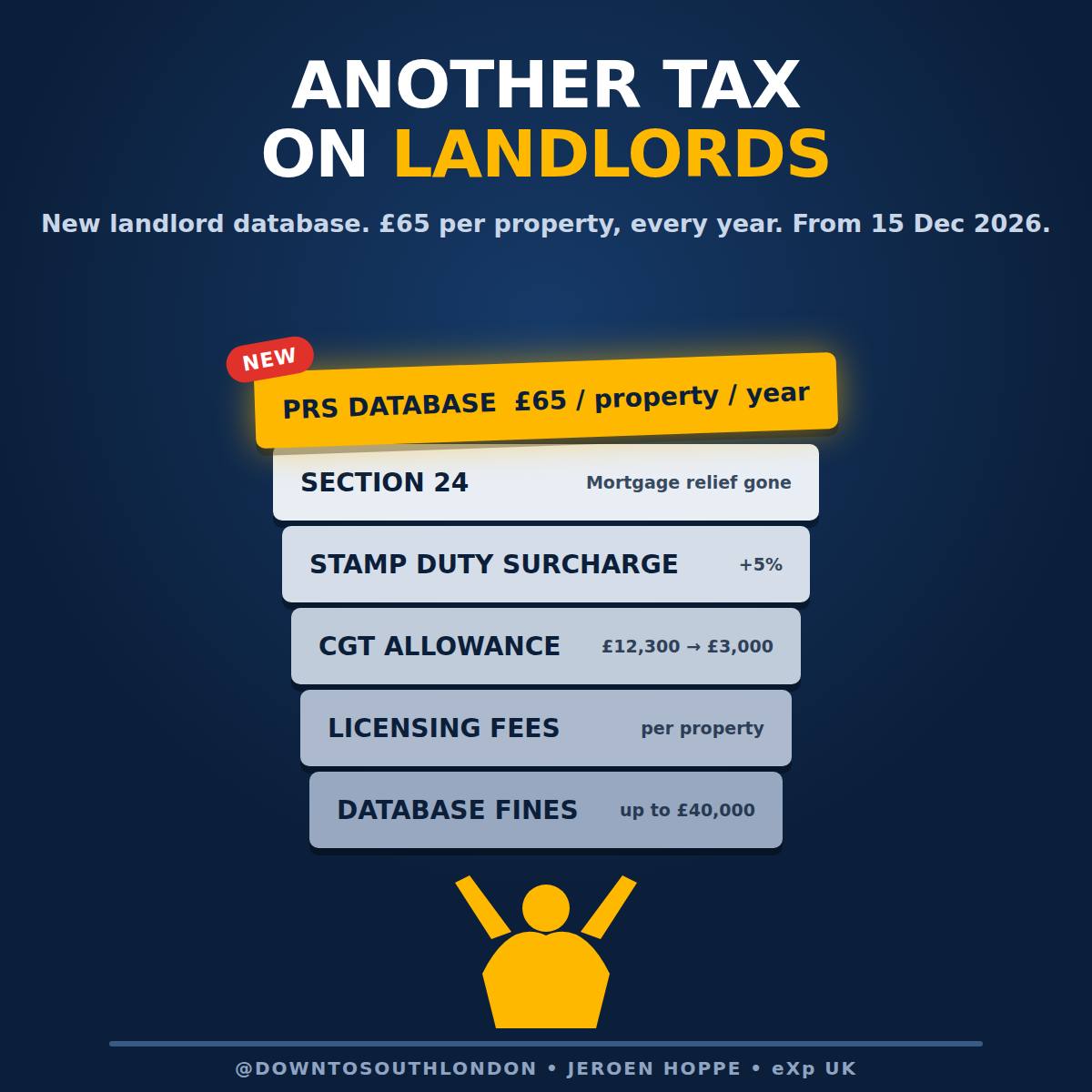
Another tax on landlords: the new £65-a-year landlord database explained

Another tax on landlords - new PRS database £65 per property per year

The government has confirmed it. The new Private Rented Sector Database, the "landlord register" everyone has been talking about since the Renters' Rights Act, goes live on 15 December 2026.

Here is what it actually means for you if you own a rental property:

£65 per property. Per year. Not a one-off. You pay it on registration and you pay it again every year to renew. Five flats? That is £325 a year, every year, just to have your name on a list.

You cannot delegate it. Your agent cannot register the property for you. You have to log in and do it yourself, property by property, uploading the address, the rent, the number of bedrooms, who lives there, gas safety, EICR and EPC certificates.

Miss it and the fine is up to £7,000. Get it wrong, or keep getting it wrong, and it is up to £40,000.

No registration number, no advert. Agents will be banned from marketing a property that has not been registered. So if you are late, your property sits empty while you sort the paperwork.

It rolls out region by region. West Midlands first in December, London from 15 July 2027 with a deadline of 14 October 2027.

Now let's be honest about what this is

This is not about rogue landlords. Rogue landlords do not register for things. They never have. The people who will dutifully log in, pay their £65 and upload their certificates are the same landlords who were already doing everything right.

Let's stack it up. In the last decade the private landlord has lost mortgage interest relief (Section 24), paid a 3% then 5% stamp duty surcharge on every purchase, watched the capital gains allowance cut from £12,300 to £3,000, faced the end of Section 21, seen selective licensing spread borough by borough at several hundred pounds a go, and now has to fund a database on top. Each one on its own is "only" a small charge. Together they are the reason so many good landlords have sold up.

And here is the bit the politicians never say out loud: landlords do not absorb costs. They pass them on. Every one of these charges ends up in the rent. Fewer landlords means fewer rental homes, which means higher rents. The person paying for this database is the tenant it claims to protect.

I have been an agent in South London for over 20 years. I speak to landlords every week who are tired. Not of tenants, not of the work, but of being treated as the problem to be solved rather than the people providing 4.6 million homes the state has no way of replacing.

If you are a landlord, here is my advice

  1. Do not panic, London is not until July 2027. But diarise it now.
  2. Get your certificates in order this year. Gas, EICR, EPC. If any of them are missing you will not be able to register.
  3. Budget £65 per property into your annual numbers and, frankly, into your rent review.
  4. If you have been thinking about selling, know that the market is still moving and good stock is still selling. Do it on your terms, not because a fine forced you.

If you want a straight conversation about what your property is worth today, either to let or to sell, get in touch. No sales pitch, just 20 years of knowing this market.

Sources: NRLA, Property118, Landlord Today, The Independent Landlord (September 2026).


---------

07837 093 554

Friday, 4 September 2026

The Renters' Rights Act is here - the Clapham landlord's real to-do list

Black and white caricature of a worried landlord with gavel and paperwork

There's a particular look I've seen a lot lately across the desk from Clapham landlords: part resignation, part "just tell me what I actually have to do." The Renters' Rights Act has been talked about for so long that some owners have switched off entirely. That's the mistake. As one industry voice put it bluntly this week, this is a storm agents and landlords cannot simply wait out. So instead of another doom-laden overview, here's the practical version for anyone letting a flat round here.

First, understand what's genuinely changed. The Act ends the old no-fault route landlords relied on and moves everything onto a system where you need a proper legal ground to seek possession. To cope with the extra disputes, the government has been recruiting around 1,000 new judges for the courts that will handle these cases - a detail that tells you how much more of this will end up formally contested rather than settled with a quiet notice. There are new specific grounds too, including a student-possession ground (Ground 4A) that matters if you let to sharers on academic-year cycles, as plenty of landlords near the commons and around Battersea do.

Second, get your compliance genuinely in order, not "mostly". The days of a relaxed attitude to paperwork are over, because when possession has to go through a ground, your evidence trail is everything. That means a current, valid EPC, gas and electrical safety certificates in date, deposit protected and prescribed information served, and a tenancy agreement that reflects the new rules rather than a template from three years ago. If any of that is shaky, sort it before you need it, not after a dispute has started.

Third, think carefully about rent. Tribunals are already pushing back hard on increases - one analysis of around 200 determinations found roughly 73% of proposed rises were cut. The lesson for a Clapham landlord isn't to give up on fair increases, it's to make them evidence-based and defensible: know your comparable rents on your own street, document them, and price a review where you'd be comfortable justifying it, rather than reaching for a number and hoping it sticks.

Here's my take. I understand why some landlords are heading for the exit, and I've written before about the sell-off. But for those staying, panic is not a plan and neither is denial. The landlords who'll do fine under this Act are the organised, professional ones - the people who treat letting like the business it now clearly is, keep their properties in good order, and build genuine relationships with good tenants they want to keep. In a market this short of rental homes, a reliable tenant in a well-run flat is an asset worth protecting, not a liability to manage at arm's length.

Are you a landlord in Clapham or nearby trying to work out what the Renters' Rights Act means for your flat? Send me your situation and I'll give you a straight, practical steer - no scaremongering. Email jeroen@claphampropertyblog.com or call 07837 093554.

Wednesday, 2 September 2026

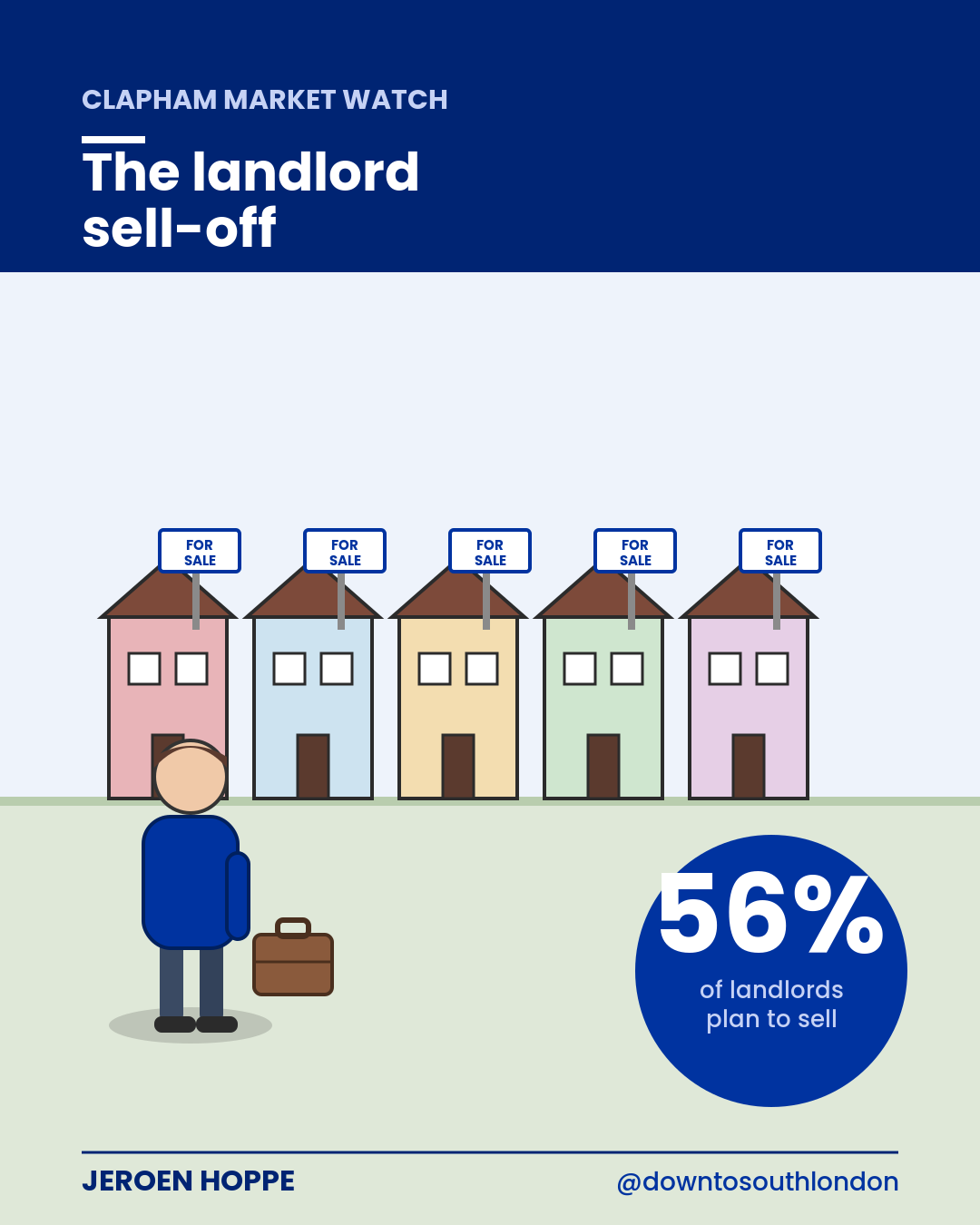
56% of landlords now plan to sell - and Clapham's flats are first in line

Cartoon landlord leaving a row of Clapham terraces with For Sale boards

Every few weeks another buy-to-let landlord walks into my office with the same opening line: "I think I'm done." Usually it's someone who bought a one or two-bed flat off Clapham Common or near Abbeville Village years ago, has had a decent run, and is now quietly worn down by the paperwork, the mortgage rates and the sense that the rules keep moving against them. This week the numbers caught up with the mood on my sofa.

The Deposit Protection Service's latest review found that 56% of landlords now plan to sell some or all of their portfolio, up from 53% last October. Pair that with Benham and Reeves reporting that just 3.9% of landlords intend to expand, and you have a private rented sector that is shrinking at one end and barely growing at the other. The English Private Landlord Survey adds the detail that matters locally: landlords with five or more properties account for 49% of all private tenancies, despite being only 17% of landlords. In other words, a small number of committed players hold up a big share of the market, and when they start heading for the door, the effect is outsized.

Down here that plays out flat by flat. Clapham, Balham and Stockwell are stuffed with the exact stock these landlords own - period conversions and purpose-built one and two-beds that were the classic first buy-to-let. When one of them sells, the flat often goes to an owner-occupier rather than another investor, so it leaves the rental pool for good. Multiply that across a few streets and you can see why renters near the Common tell me every viewing feels like a scrum. Void periods have actually fallen to around 21 days nationally, which is another way of saying good rental flats are being snapped up almost as fast as they appear.

Here's my honest take, and it cuts both ways. If you're a landlord who has genuinely had enough, selling into today's market is not the disaster some headlines suggest - owner-occupier demand for a well-presented Clapham flat is real, and you may do better selling with vacant possession to a homebuyer than to a nervous investor. But if your numbers still work, think hard before you join the stampede. Fewer rental flats plus steady tenant demand is, bluntly, a supportive backdrop for the landlords who stay. The ones selling in a panic may be handing a stronger position to the ones who hold their nerve.

Either way, the worst move is to drift. If you own a flat round here and you're on the fence, get a proper, current valuation and a straight read on your yield before you decide - not a guess based on what your neighbour got in 2021.

Are you a Clapham landlord weighing up whether to sell or sit tight this year? I talk this through with owners most weeks and I'm happy to give you a straight steer. Email me at jeroen@claphampropertyblog.com or call 07837 093554.


Virus-free.www.avast.com

Tuesday, 1 September 2026

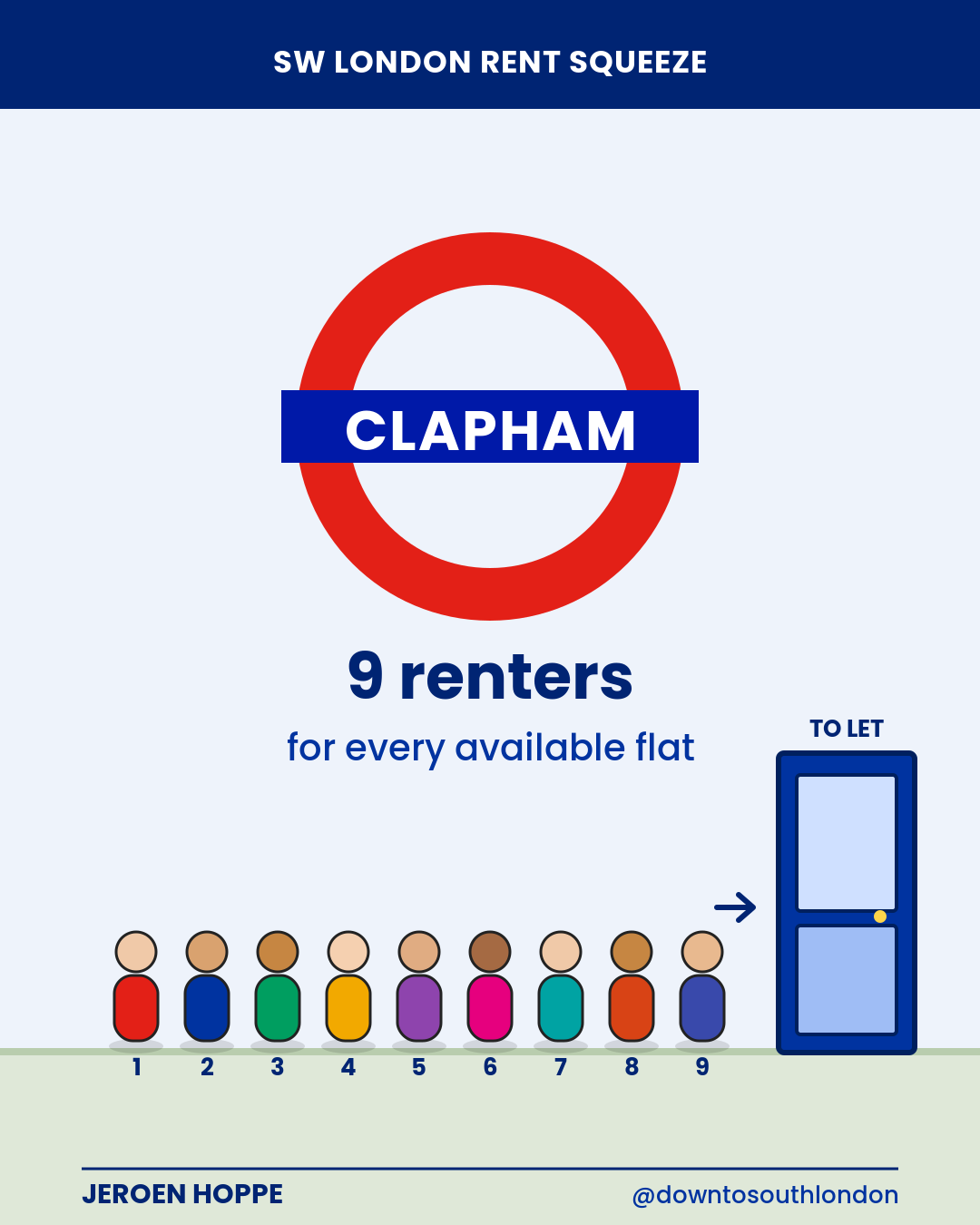
Nine renters for every flat: inside the SW London rent squeeze

Clapham roundel with nine tenants queuing for a flat

Walk past any letting board near Clapham Common on a Saturday and you'll spot it - a small knot of people outside a flat, phones out, all there for the same 20-minute viewing slot. Down here that queue isn't a one-off, it's the market. And this week the national figures finally put a shape to what renters round here already feel in their gut.

The Office for National Statistics reports that average private rents rose 3.7% in the 12 months to July 2026, with the UK average private rent now sitting at 1,393 pounds a month. Separate reporting this week put annual rental growth as high as 4.3% and estimated that tenants are now spending roughly a third of their income on housing. The Institute for Fiscal Studies goes further still, finding renters spent about 28% of household income on housing in 2024-25. And the story behind the queues is supply: with reports of as many as nine renters chasing every available flat, there simply aren't enough homes to go round.

In Clapham, Balham, Brixton and Stockwell those national averages are a soft-focus version of the truth, because London rents start well above 1,393 pounds and the competition is fiercer. When a two-bed conversion off Abbeville Road comes up, it doesn't sit - it's gone in days, often to whoever can move fastest and offer cleanest. That's the bit the percentages don't capture: the couple who've been outbid three times since June, the sharers stretching to a postcode they can just about afford, the tenant who renews at a higher rent simply because moving feels riskier than staying. Rising rents and thin supply don't just cost money, they cost people their options.

My take, and renters won't always want to hear it: in a market this tight, preparation beats hope. If you're flat-hunting in SW London right now, be viewing-ready before you turn up - references lined up, proof of income to hand, a realistic budget that includes the deposit and first month, and a genuine sense of which streets you'll actually accept. The renters who lose out are rarely the ones offering the most; they're the ones who dither while someone more organised says yes. And if you're a good tenant already in a decent flat, think twice before walking away from it in this climate - a rent you can negotiate is often better than a search you can't win.

None of this is a lecture. The squeeze is real and it's structural, and it won't ease until more rental homes come back into the market rather than leaving it. But knowing the numbers - and knowing your patch - is how you stop being the ninth person in the queue and start being the one who gets the keys.

Renting in Clapham or the surrounding area and feeling the crunch? Tell me what you're up against - I know this local market inside out and I'm glad to point you in the right direction. Reach me at jeroen@claphampropertyblog.com or call 07837 093554.


Virus-free.www.avast.com

Thursday, 27 August 2026

Four Out of Five Homes That Sell Never Drop Their Price. What That Tells You About Selling in Clapham

Four out of five homes that sell never drop their price

There is a flat on a road off the Common that has been sitting on Rightmove since spring. Nice flat. Good road. Nothing wrong with it at all, except the number on the front of it. A vendor I met last week asked me why it still had not gone, and the honest answer is the one nobody wants to hear at a valuation: it launched at a price the market did not believe, and every week since has been spent slowly proving that.

Some numbers landed on LinkedIn this week that make the point better than I can. Data from Sprift, covering 710,729 homes that came onto the UK market since 1 January 2026: only 238,105 of them have had a sale agreed. That is a third. Two out of every three sellers who launched this year are still waiting.

Now the part that should change how you think about your asking price. Of the 238,105 that did sell, 80.08% sold without a single price reduction, and they did it in an average of 28 days. The 20% that needed a reduction took an average of 64 days to get a sale agreed. Same market, same month, same buyers. More than double the time, and a lower price at the end of it.

Down here the pattern is identical. Across SW4 in June there were 136 homes on the market and 40 of them found a buyer. The flats sitting on the market carried a median asking price of £525,000; the flats that actually got agreed did so at a median of £475,000. On average an SW4 home took 52 days to go under offer, which is quicker than the national 59 - our market is not slow, it is just unforgiving of a punchy number.

Here is what that means in practice if you are selling in Clapham, Balham, Stockwell or Abbeville Village this autumn. Your first two to three weeks are the whole ballgame. That is when every buyer already registered and hunting sees your flat for the first time, when the portal alerts fire, and when your viewing diary is at its fullest. Price it right and you are choosing between offers while the launch buzz is live. Price it 8% high to "test the market" and those same buyers scroll past, you get the trickle rather than the flood, and eight weeks later you reduce to the number you should have started at - only now every buyer can see how long it has been sitting and treats you accordingly. The reduction does not fix the problem. It advertises it.

My take, and I will say it to any vendor who asks: never let anyone value your home on what you want it to be worth, including me. Value it on the last three genuinely comparable sales on your street or the one next to it, then decide whether you want to sell or you want to advertise. Testing the market is not a free option. It costs you five weeks, your best buyers, and usually more money than the reduction you were trying to avoid.

Are you sitting on a home that has been out there too long, or thinking about launching this autumn and wondering where the number should be? Tell me the road and I will tell you straight what I think it will actually sell for. Drop me a line at jeroen@claphampropertyblog.com or call 07837 093554.
Sources: Sprift listing data (1 January to August 2026), shared on LinkedIn; SW4 monthly market data, June 2026.

Monday, 17 August 2026

Record stock, falling prices: why this is the best autumn to buy in Clapham for years

 Walk past any of the estate agents around Clapham Old Town this month and the windows tell the story before I do. There are more boards up than I have seen in a long while, and a good few have quietly grown a "reduced" sticker. If you have been sitting on your hands waiting for the London market to blink, it just did.


Rightmove's latest figures, out this week, put some numbers on what we are all feeling on the ground. The average new asking price across the country fell 2% this month to £364,999, the biggest monthly drop they have recorded since 2018. The reason is simple: supply. There are more homes on the market now than at any point in 12 years, and when buyers have that much choice, sellers have to compete. Rightmove went further and called London the worst-performing part of Britain by almost every measure, with agents at Hamptons and Connells reporting that sellers are increasingly cutting asking prices to get a deal done.


Down here that plays out street by street. A two-bed flat off Abbeville Road or a terraced house near the Common is no longer the only show in town. Buyers who missed out on three places last spring are suddenly the ones with the whip hand, walking into second viewings knowing there is another perfectly good flat round the corner. For sellers it means the days of sticking an optimistic number on the listing and waiting are over. Price it to the market from day one, or watch it drift and pick up the "reduced" sticker that quietly tells every buyer you got it wrong.


Here is my honest take, and it will not suit everyone. If you are a buyer in a position to move, this is the strongest hand you will have held in Clapham for years. Not because prices are collapsing, they are not, but because choice plus nervous sellers plus softer mortgage rates is a genuine window. Lenders have been trimming again, with several buy-to-let and residential rates edged down over the past fortnight, and a motivated seller in a 12-year-high market has every reason to take a sensible offer rather than gamble on the autumn. That combination does not come around often.


For sellers, do not panic and do not believe anyone who tells you the market has fallen out of bed, because it has not. What has changed is that presentation and pricing now do all the heavy lifting. The homes moving well around Clapham and Balham are the ones that are sensibly priced, properly photographed and ready to view. Get those three right and you will still sell, and sell well. Get greedy on the asking price in a market this well stocked and you will simply hand the advantage to the flat down the road.


So the question I would leave you with: are you a buyer who has been waiting for exactly this, or a seller wondering whether to launch now or hold until spring? There is no single right answer, but there is a right answer for your situation, and it is worth talking through before you commit either way.


Thinking about a move in Clapham or the surrounding area this year, or just want a straight view on what your place would really fetch today? Drop me a line at jeroen@claphampropertyblog.com or call 07837 093554. I am always happy to talk it through.
Friday, 7 August 2026

The Quiet Landlord Exodus: Why South London Renters Should Be the Ones Worrying


Drive around Clapham, Balham or Brixton at the moment and you start to notice something. Flats that were quietly let for years are appearing on the sales portals. A landlord I have known for a decade told me last week he is cashing in two of his three flats near the Common. He is not angry about it. He has just done the maths - and the maths has changed.


Here is what is actually happening, away from the headlines. Property118 reported this week that Capital Gains Tax changes are now the single biggest reason landlords are selling. At the same time, the landlords who are staying in are restructuring hard: company incorporations are up an extraordinary 1,700% as buy-to-let owners move their portfolios into limited companies to shelter what they can from the tax. Overall landlord sentiment, on every survey I read, is weak and getting weaker.


That might sound like a landlord's problem. It isn't. It is a renter's problem, and in South London it is becoming an acute one.


Follow the chain. Every flat a landlord sells to an owner-occupier is a flat that leaves the rental pool for good. Propertymark now counts roughly eight renters chasing every available property. Nationwide has rents up 3.3% over the year, even as house-price growth has cooled to 1.8% - a telling split, because it shows demand pouring into renting exactly as supply drains out of it. Fewer rental homes plus more tenants competing for them equals one thing: higher rents and less choice for the very people the tax changes were never meant to hurt.


This is the uncomfortable truth I keep coming back to. We have spent several years making it less attractive to be a private landlord - higher taxes, more regulation, less flexibility - in the name of helping renters. But you cannot help renters by shrinking the number of homes available to rent. If the goal was genuinely to improve life for tenants in Clapham and across SW London, the answer was always going to be more homes, not fewer landlords.


So what do I tell people? Landlords: don't make an emotional decision. If you own a good flat in a strong South London location, the case for holding - or incorporating and holding - is often stronger than the case for selling into a flat market. The demand for your property has arguably never been higher. Renters: understand that the squeeze is structural, not a blip. When a well-priced flat comes up in the area you want, be ready to move fast, have your references and paperwork in order, and treat a good landlord as someone worth keeping.


Are you a South London landlord weighing up whether to sell or restructure, or a renter feeling the squeeze first-hand? I would really like to hear from you - drop me a line at jeroen@claphampropertyblog.com or call me on 07837 093554.

Thursday, 6 August 2026

Fewer Sales, Longer Waits: Why Is Conveyancing Slower Than Ever?


There is a strange contradiction running through the property market right now, and if you are trying to buy or sell in South London you have probably felt it without being able to put your finger on it.

Fewer homes are actually changing hands. And yet every sale that does happen seems to crawl along more slowly than ever before.

That should not make sense. When there is less work in the system, things ought to move faster, not slower. So what is going on?

The numbers behind the frustration

Transaction volumes have cooled noticeably. HMRC's figures showed completed residential sales down again through the spring, and Zoopla's research points to stamp duty quietly dragging on activity across the south of England in particular. There are simply fewer deals in the pipeline than there were a year or two ago.

But here is the part that catches everyone out. The average time to get from an agreed sale to exchange of contracts has now stretched to around 125 days. Split that out and it is roughly 111 days for a freehold and 133 days for a leasehold. Back in 2019, before the pandemic reshaped everything, the same journey took closer to 76 days.

So the workload across the industry is lighter, but the process has never been slower. Four months, on average, from "yes" to legally committed — and often longer if there is a leasehold or a chain involved.

Where the time actually goes

I spend my working life on the phone chasing these transactions along, so let me tell you what I am seeing on the ground.

With fewer files to work through, a worrying number of solicitors seem to have gone looking for reasons to slow things down rather than reasons to move them forward. Enquiries that used to be handled in a quick line of correspondence now come back as a two-page list. Perfectly clean titles get picked apart. A missing FENSA certificate on a window replaced fifteen years ago becomes a three-week standoff. One industry commentator recently called it "death by due diligence," and honestly that is exactly what it feels like.

I want to be fair here. Nobody wants to be the professional who missed something, and a good conveyancer is protecting their client from real risk. That is their job and it matters. But there is a meaningful difference between protecting a client and manufacturing friction — and too much of what is slowing transactions down right now falls into the second category.

Why delay is so dangerous

Every extra week a transaction sits open is another week for something to go wrong. A buyer gets cold feet. A mortgage offer edges towards expiry. Someone further up or down the chain pulls out and takes everyone with them.

The data backs this up. Nearly one in four sales that fall through now collapse after the three-month mark, up sharply from a few years ago. And a large share of those late collapses have nothing to do with price or survey problems. They are about fatigue — people simply running out of patience and goodwill because the process dragged on far longer than anyone promised at the start.

That is the real cost of delay. It is not just an inconvenience. It is deals that were ready to complete quietly falling apart.

What this means if you are moving

The encouraging news is that this is not a demand problem. Buyers are still out there and good homes are still selling. What we have is a completion problem — and a lot of it is self-inflicted by the way the process is run.

If you are buying or selling, the single most useful thing you can do is choose your conveyancer on how they communicate, not just on the quote at the bottom of the page. A proactive solicitor who picks up the phone, replies to emails the same week and pushes a transaction forward is worth every penny over a cheaper firm that hides behind its inbox for a fortnight at a time. Ask how they will keep you updated. Ask how quickly they turn enquiries around. It is one of the few parts of this whole process you can genuinely influence.

Instruct early, get your paperwork ready before you even have a buyer or a purchase agreed, and stay on top of the timeline rather than assuming no news is good news.

The bottom line

The market has slowed, but the process has slowed faster — and that gap is where good deals are being lost. Picking the right people around you, and keeping the pressure on gently but consistently, is the difference between a move that completes and one that quietly falls apart.

If you are thinking about buying or selling in South London and want a straight, no-nonsense view on how to keep your move on track, I am always happy to have that conversation.

Monday, 3 August 2026

The End of Section 21: What No-Fault Eviction Reform Really Means for South London Landlords and Tenants


Walk past the lettings boards on Abbeville Road this week and nothing looks any different. But something big has just shifted under all of them. As of the 31st of July, Section 21 - the "no-fault" eviction that has underpinned the private rented sector for the best part of forty years - is history. Every assured tenancy in England is now periodic, rolling month to month, and no landlord can any longer ask a tenant to leave simply because the fixed term has run out.


If you rent in Clapham, Balham or Brixton, that is genuinely good news: your home is no longer on a two-month countdown. If you are one of the many local landlords I speak to, it is the biggest change to how you operate since the tenant fee ban. So let me cut through the noise.


The headline is simple. Fixed terms and no-fault notices are gone. To regain possession now, a landlord has to use one of the specific grounds under the new Schedule 2 - selling the property, moving back in, serious rent arrears, or a breach of the tenancy - and evidence it. Tessa Shepperson's Landlord Law bulletin has been walking through these grounds in detail, and the short version is this: possession is still possible, but it is now a reasoned process, not a rubber stamp.


Here is the bit the national headlines miss. The worry isn't the rule itself - most good landlords in SW London were never chasing people out for no reason. The worry is what it does to supply. Propertymark reported this week that there are now roughly eight renters chasing every available property. Eight. At the same time, Property118 is reporting landlords selling up in numbers, driven by Capital Gains Tax changes, with company incorporations up an eye-watering 1,700% as the ones who stay restructure. Nationwide has rents rising 3.3% over the year even as house-price growth cools to 1.8%.


Join those dots and you get the real South London story. If more landlords take the end of Section 21 as their cue to sell into a flat sales market, the pool of rental flats around the Common shrinks further - and with eight tenants per property already, it is the renter, not the landlord, who feels that most sharply. Fewer homes, more competition, higher rents. That is the opposite of what the reform set out to achieve.


My honest take? This is a good reform wrapped around a supply problem nobody has fixed. Landlords: don't panic-sell. A well-run, well-priced Clapham flat with a good long-term tenant is still one of the most resilient assets you can hold, and the new rules reward exactly that kind of landlord. Renters: the security is real, but the market is tighter than ever, so when the right place comes up, be ready to move quickly and present yourself well.


Are you a South London landlord weighing up whether to stay in or sell, or a tenant trying to make sense of your rights under the new rules? I'd genuinely love to hear where you've landed on it - drop me a line at jeroen@claphampropertyblog.com or call me on 07837 093554.

London rents just jumped 9.8% in a month. Here's what's really going on in Clapham

Stand outside any letting board on Clapham High Street for ten minutes and you'll see it: a viewing, then another, then a couple alrea...

Popular Post!