Showing posts with label Sellers. Show all posts

Thursday, 27 August 2026

Four Out of Five Homes That Sell Never Drop Their Price. What That Tells You About Selling in Clapham

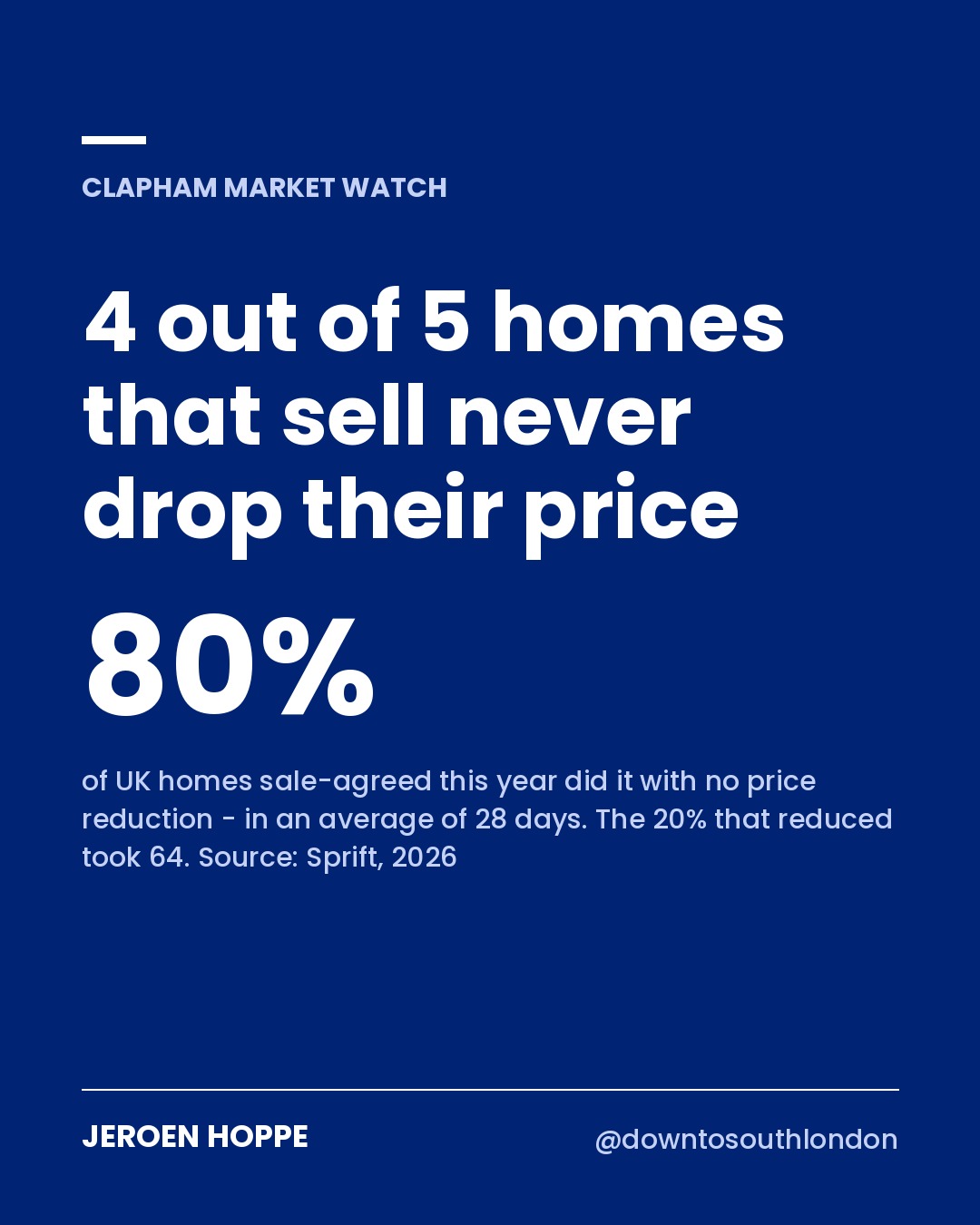
Four out of five homes that sell never drop their price

There is a flat on a road off the Common that has been sitting on Rightmove since spring. Nice flat. Good road. Nothing wrong with it at all, except the number on the front of it. A vendor I met last week asked me why it still had not gone, and the honest answer is the one nobody wants to hear at a valuation: it launched at a price the market did not believe, and every week since has been spent slowly proving that.

Some numbers landed on LinkedIn this week that make the point better than I can. Data from Sprift, covering 710,729 homes that came onto the UK market since 1 January 2026: only 238,105 of them have had a sale agreed. That is a third. Two out of every three sellers who launched this year are still waiting.

Now the part that should change how you think about your asking price. Of the 238,105 that did sell, 80.08% sold without a single price reduction, and they did it in an average of 28 days. The 20% that needed a reduction took an average of 64 days to get a sale agreed. Same market, same month, same buyers. More than double the time, and a lower price at the end of it.

Down here the pattern is identical. Across SW4 in June there were 136 homes on the market and 40 of them found a buyer. The flats sitting on the market carried a median asking price of £525,000; the flats that actually got agreed did so at a median of £475,000. On average an SW4 home took 52 days to go under offer, which is quicker than the national 59 - our market is not slow, it is just unforgiving of a punchy number.

Here is what that means in practice if you are selling in Clapham, Balham, Stockwell or Abbeville Village this autumn. Your first two to three weeks are the whole ballgame. That is when every buyer already registered and hunting sees your flat for the first time, when the portal alerts fire, and when your viewing diary is at its fullest. Price it right and you are choosing between offers while the launch buzz is live. Price it 8% high to "test the market" and those same buyers scroll past, you get the trickle rather than the flood, and eight weeks later you reduce to the number you should have started at - only now every buyer can see how long it has been sitting and treats you accordingly. The reduction does not fix the problem. It advertises it.

My take, and I will say it to any vendor who asks: never let anyone value your home on what you want it to be worth, including me. Value it on the last three genuinely comparable sales on your street or the one next to it, then decide whether you want to sell or you want to advertise. Testing the market is not a free option. It costs you five weeks, your best buyers, and usually more money than the reduction you were trying to avoid.

Are you sitting on a home that has been out there too long, or thinking about launching this autumn and wondering where the number should be? Tell me the road and I will tell you straight what I think it will actually sell for. Drop me a line at jeroen@claphampropertyblog.com or call 07837 093554.

Sources: Sprift listing data (1 January to August 2026), shared on LinkedIn; SW4 monthly market data, June 2026.


Monday, 17 August 2026

Record stock, falling prices: why this is the best autumn to buy in Clapham for years

 Walk past any of the estate agents around Clapham Old Town this month and the windows tell the story before I do. There are more boards up than I have seen in a long while, and a good few have quietly grown a "reduced" sticker. If you have been sitting on your hands waiting for the London market to blink, it just did.


Rightmove's latest figures, out this week, put some numbers on what we are all feeling on the ground. The average new asking price across the country fell 2% this month to £364,999, the biggest monthly drop they have recorded since 2018. The reason is simple: supply. There are more homes on the market now than at any point in 12 years, and when buyers have that much choice, sellers have to compete. Rightmove went further and called London the worst-performing part of Britain by almost every measure, with agents at Hamptons and Connells reporting that sellers are increasingly cutting asking prices to get a deal done.


Down here that plays out street by street. A two-bed flat off Abbeville Road or a terraced house near the Common is no longer the only show in town. Buyers who missed out on three places last spring are suddenly the ones with the whip hand, walking into second viewings knowing there is another perfectly good flat round the corner. For sellers it means the days of sticking an optimistic number on the listing and waiting are over. Price it to the market from day one, or watch it drift and pick up the "reduced" sticker that quietly tells every buyer you got it wrong.


Here is my honest take, and it will not suit everyone. If you are a buyer in a position to move, this is the strongest hand you will have held in Clapham for years. Not because prices are collapsing, they are not, but because choice plus nervous sellers plus softer mortgage rates is a genuine window. Lenders have been trimming again, with several buy-to-let and residential rates edged down over the past fortnight, and a motivated seller in a 12-year-high market has every reason to take a sensible offer rather than gamble on the autumn. That combination does not come around often.


For sellers, do not panic and do not believe anyone who tells you the market has fallen out of bed, because it has not. What has changed is that presentation and pricing now do all the heavy lifting. The homes moving well around Clapham and Balham are the ones that are sensibly priced, properly photographed and ready to view. Get those three right and you will still sell, and sell well. Get greedy on the asking price in a market this well stocked and you will simply hand the advantage to the flat down the road.


So the question I would leave you with: are you a buyer who has been waiting for exactly this, or a seller wondering whether to launch now or hold until spring? There is no single right answer, but there is a right answer for your situation, and it is worth talking through before you commit either way.


Thinking about a move in Clapham or the surrounding area this year, or just want a straight view on what your place would really fetch today? Drop me a line at jeroen@claphampropertyblog.com or call 07837 093554. I am always happy to talk it through.

Thursday, 6 August 2026

Fewer Sales, Longer Waits: Why Is Conveyancing Slower Than Ever?


There is a strange contradiction running through the property market right now, and if you are trying to buy or sell in South London you have probably felt it without being able to put your finger on it.

Fewer homes are actually changing hands. And yet every sale that does happen seems to crawl along more slowly than ever before.

That should not make sense. When there is less work in the system, things ought to move faster, not slower. So what is going on?

The numbers behind the frustration

Transaction volumes have cooled noticeably. HMRC's figures showed completed residential sales down again through the spring, and Zoopla's research points to stamp duty quietly dragging on activity across the south of England in particular. There are simply fewer deals in the pipeline than there were a year or two ago.

But here is the part that catches everyone out. The average time to get from an agreed sale to exchange of contracts has now stretched to around 125 days. Split that out and it is roughly 111 days for a freehold and 133 days for a leasehold. Back in 2019, before the pandemic reshaped everything, the same journey took closer to 76 days.

So the workload across the industry is lighter, but the process has never been slower. Four months, on average, from "yes" to legally committed — and often longer if there is a leasehold or a chain involved.

Where the time actually goes

I spend my working life on the phone chasing these transactions along, so let me tell you what I am seeing on the ground.

With fewer files to work through, a worrying number of solicitors seem to have gone looking for reasons to slow things down rather than reasons to move them forward. Enquiries that used to be handled in a quick line of correspondence now come back as a two-page list. Perfectly clean titles get picked apart. A missing FENSA certificate on a window replaced fifteen years ago becomes a three-week standoff. One industry commentator recently called it "death by due diligence," and honestly that is exactly what it feels like.

I want to be fair here. Nobody wants to be the professional who missed something, and a good conveyancer is protecting their client from real risk. That is their job and it matters. But there is a meaningful difference between protecting a client and manufacturing friction — and too much of what is slowing transactions down right now falls into the second category.

Why delay is so dangerous

Every extra week a transaction sits open is another week for something to go wrong. A buyer gets cold feet. A mortgage offer edges towards expiry. Someone further up or down the chain pulls out and takes everyone with them.

The data backs this up. Nearly one in four sales that fall through now collapse after the three-month mark, up sharply from a few years ago. And a large share of those late collapses have nothing to do with price or survey problems. They are about fatigue — people simply running out of patience and goodwill because the process dragged on far longer than anyone promised at the start.

That is the real cost of delay. It is not just an inconvenience. It is deals that were ready to complete quietly falling apart.

What this means if you are moving

The encouraging news is that this is not a demand problem. Buyers are still out there and good homes are still selling. What we have is a completion problem — and a lot of it is self-inflicted by the way the process is run.

If you are buying or selling, the single most useful thing you can do is choose your conveyancer on how they communicate, not just on the quote at the bottom of the page. A proactive solicitor who picks up the phone, replies to emails the same week and pushes a transaction forward is worth every penny over a cheaper firm that hides behind its inbox for a fortnight at a time. Ask how they will keep you updated. Ask how quickly they turn enquiries around. It is one of the few parts of this whole process you can genuinely influence.

Instruct early, get your paperwork ready before you even have a buyer or a purchase agreed, and stay on top of the timeline rather than assuming no news is good news.

The bottom line

The market has slowed, but the process has slowed faster — and that gap is where good deals are being lost. Picking the right people around you, and keeping the pressure on gently but consistently, is the difference between a move that completes and one that quietly falls apart.

If you are thinking about buying or selling in South London and want a straight, no-nonsense view on how to keep your move on track, I am always happy to have that conversation.

The £65 landlord register is here - what every Clapham landlord needs to do now

I had a call this week from a landlord who owns one flat near Clapham Common - a flat she used to live in, now let to a lovely couple. ...

Popular Post!