Saturday, 31 October 2026

Your First Home: a 2.5% deposit scheme - but will it help first-time buyers in Clapham, Brixton and Streatham?

Your First Home 2.5% deposit scheme - what it means for Clapham, Brixton and Streatham

A 2.5% deposit. For first-time buyers in South London that sounds too good to be true. So what did the Budget actually confirm?

So what's happening?

The government has confirmed a new £4.7 billion equity loan scheme called Your First Home. It aims to help around 70,000 households in England onto the ladder. What GOV.UK has published so far:

  • You put down a deposit of at least 2.5%, up to a maximum of 15%.
  • The government lends you 20% of the price as an equity loan.
  • The rest is a repayment mortgage from a participating lender.
  • The equity loan is interest free for five years, then 1.5% in year six and 3% from year seven.
  • Household income must be £140,000 or less in London (£110,000 elsewhere).
  • Price caps are £650,000 in inner London and £500,000 in outer London.
  • It's for first-time buyers, for your main home, and only for new-build homes from developers signed up to the scheme.

Pre-registration opens by the end of December 2026, full applications from February 2027 and the first loans from April 2027.

The cold hard facts

Bear in mind it's an equity loan, not free money. If you borrow 20%, you pay back 20% of what the home is worth when you repay. GOV.UK's own example: buy at £300,000, borrow £60,000, and if the home is later valued at £320,000 you repay £64,000.

On a £500,000 new-build flat, that works out as:

  • Deposit (2.5%): £12,500
  • Equity loan (20%): £100,000
  • Mortgage: £387,500

You still need to pass the lender's affordability checks, of course.

But what does it mean for Clapham, Brixton and Streatham?

You see, here's the thing. Most of what first-time buyers buy round here is second-hand: period conversions off Abbeville Road, flats on Brixton Hill, mansion blocks in Streatham. None of that qualifies. This is a new-build scheme, full stop.

Where it could matter is new-build in Battersea and Nine Elms, plus the odd new block in Brixton or Streatham, if the developer signs up and the price sits under the cap. Lambeth and Wandsworth should count as inner London, but the full list of local caps isn't published yet, so I'd wait for that before getting excited.

Two more Budget changes worth knowing

  • Since 29 October 2026, you can use a Lifetime ISA on a home above the £450,000 cap with a 20% withdrawal charge instead of 25%. That's a real help in SW4, where £450,000 doesn't go far.
  • From April 2029, a new First Time Buyer ISA replaces the Lifetime ISA for new savers: up to £4,000 a year, a 25% bonus and no upper age limit.

My take

It's a genuine leg-up for buyers who'd happily take a new-build flat. But it does nothing for the period stock most people in Clapham and Brixton actually want, and an equity loan that grows with your home's value is a debt you'll need a plan to repay. Take independent advice first.

So there you have it. Would you buy a new-build to get on the ladder with just 2.5% down, or hold out for a period flat? Drop me a line at jeroen@claphampropertyblog.com or call 07837 093554.

---------
07837 093 554

Sources: GOV.UK, Budget 2026 and "Your First Home" guidance (MHCLG), 28 October 2026.

Friday, 30 October 2026

Tenants told to 'flood' rent tribunals: a backdoor rent freeze that could backfire on Clapham and Battersea renters

Tenants told to flood rent tribunals - Clapham and Battersea

Let me say it straight. Telling tenants to challenge every rent rise, fair or not, isn't tenant protection. It's gaming the system, and in Clapham and Battersea it's renters who'll end up paying for it.

What's actually happening?

Under the Renters' Rights Act, in force since May, landlords can raise the rent only once a year, and tenants can challenge the increase at the First-tier Tribunal for £47. While the case runs, the tenant keeps paying the old rent.

The Telegraph reported last week that renters' unions in Oxford, London and Manchester are urging tenants to challenge rises even when they can afford them. Oxford Renters Union says decisions are taking five to six months. The more people apply, it says, the longer everyone pays the lower rent.

The case campaigners love

In Manchester, a landlord asked to go from £1,650 to £1,700 a month. The tribunal looked at the market evidence and set £1,450 instead. That's £2,400 a year less, not £600 more. The housing minister shared it on X as an example of the system working.

And in a way, it was. If the evidence says the rent is too high, the tenant should win. Propertymark's research shows tribunals weigh floor areas and room sizes differently by region, and outstanding repairs count against the landlord. Tired flats at top-of-the-market rents deserve to be challenged.

Where I part company with the campaigners

A safeguard against silly rent hikes is one thing. Clogging it up on purpose to create a backdoor rent freeze is another. The NRLA calls it using "the frailty in the system", and that's exactly what it is.

Here's the local maths. In my experience, a typical two-bed in Clapham and Battersea rents for around £2,500 a month. Say a landlord proposes a modest £75 rise, 3%. If a tactical challenge drags on for six months, that's £450 they never get back, even if the rise was fair all along.

Some landlords will shrug. Others will sell. Supply around here is tight enough already, and every flat that leaves the rental market means more people chasing fewer homes. That's the real cost of flooding the tribunals, and it lands on the next renter, not the landlord.

There's another catch. A system jammed with tactical cases is slower for the tenant facing a genuinely unfair jump, the very person it was built for.

Who wins and who loses?

  • Renters facing an above-market rise: challenge it. That's what the tribunal is for.
  • Fair landlords with the place in good repair: little to fear, but expect delay.
  • Landlords chasing top rents on tired flats: most exposed, and rightly so.

What I'd do now

  1. Build an evidence file before you serve the notice: three or four genuinely comparable lets, same size, same condition, same area.
  2. Fix any outstanding repairs first.
  3. Talk to your tenant before the paperwork. A modest, explained rise is far less likely to be challenged.

The good news? The Tenancy Deposit Scheme found 50% of landlords kept rents unchanged over the past 12 months, up from 39%. Plenty already prefer keeping a good tenant to squeezing one.

Over to you

Fair play or an own goal? Landlord or renter, I'd genuinely like to hear your view. Drop me a line at jeroen@claphampropertyblog.com or call 07837 093554.

---------
07837 093 554

Sources: The Telegraph, Property118, Landlord Law Newsround, Propertymark, Tenancy Deposit Scheme via Letting Agent Today and Property Reporter.

Thursday, 29 October 2026

Landlord licensing is changing again. I'm not waiting to find out the hard way

Landlord licensing is changing again - Clapham, Brixton, Battersea and Peckham

Landlord licensing in South London has changed a lot in the last two years, and it's about to change again. So this week, rather than waiting for a letter from the council to land on a landlord's doormat, I got on the front foot.

What's changing?

A quick recap of where my patch stands:

  • Lambeth extended selective licensing to Clapham, Brixton, Stockwell and Kennington in September 2025, so it now covers every ward except Vauxhall and Waterloo & South Bank. Its borough-wide additional HMO scheme, for shared houses, is due to end on 8 December 2026, and I couldn't find a replacement on the council's website.
  • Wandsworth started selective licensing in Furzedown, Tooting Bec, Tooting Broadway and South Balham in July 2025, and added Northcote, East Putney and West Putney in April 2026. The council has confirmed to me that no further wards have been announced. Shared houses with up to four sharers now need an additional licence anywhere in the borough.
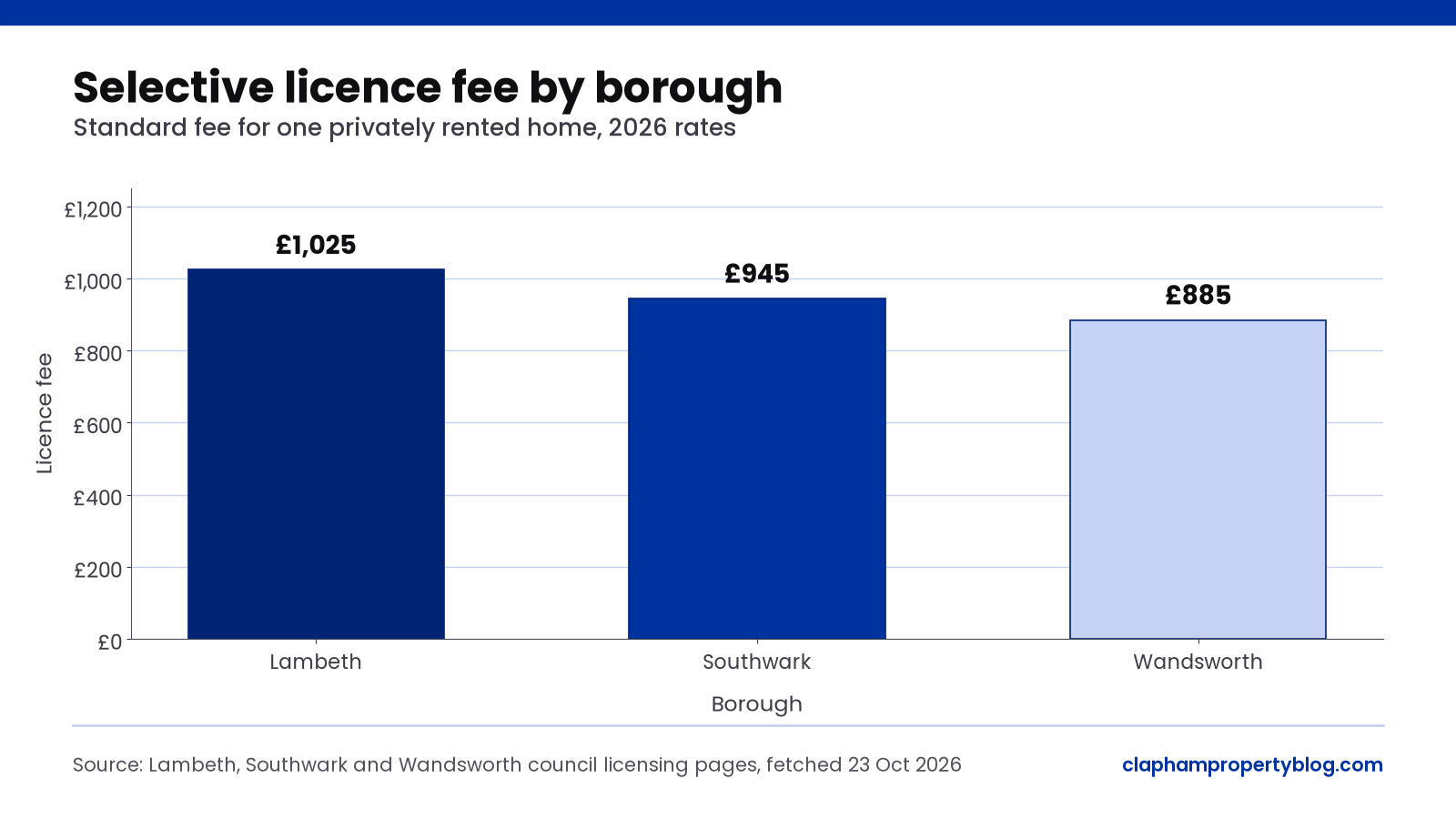
  • Southwark covers 19 wards, including most of Peckham and East Dulwich. The council has confirmed its fees are £945 for a selective licence and £1,433 for an additional licence. The current scheme runs until 2027, and a replacement will start from the day it expires.
  • Lewisham has had selective licensing across most of the borough since July 2024, and the council has told me its additional HMO scheme carries on for the foreseeable future.

Fees run from about £640 to over £1,500, and in Lambeth the penalties for getting it wrong include a fine of up to £40,000 and having to pay back up to 24 months' rent. That is not a letter anyone wants to open.

So what have I done?

Two things.

First, I've written to the licensing teams at Lambeth, Wandsworth, Southwark and Lewisham. I've asked each one what happens next: are schemes being renewed, are new wards coming in, are fees changing, and what happens to licences that run past the end of a scheme.

Second, I'm writing to every landlord I look after in Lambeth and Wandsworth. Each one will hear where their property stands under their council's scheme, and that I'm already chasing the council for answers on their behalf.

No landlord of mine should have to find out from a council enforcement officer that the rules changed.

Why bother?

Here's the thing. Most of this isn't strictly my job. A landlord holds their own licence. But a good agent spots what's coming before it becomes a problem, and these schemes are exactly the kind of thing a busy landlord with one or two flats can easily miss.

That's the difference between an agent who collects rent and one who actually looks after your investment.

What happens next?

Wandsworth, Lewisham and Southwark have already replied, and the details above reflect what they told me. Lambeth is still due. As soon as they reply, I'll update my landlords, and I'll share what I learn here too. If you're a landlord in Clapham, Brixton, Battersea, Peckham or Lewisham and you're not sure whether your let is licensed, or whether your licence is about to be caught out by a scheme ending, I'm happy to take a look. No strings attached.

So there you have it. The rules keep moving, and I'd rather be a step ahead than a step behind.

As always, are you a landlord who isn't sure where your property stands? I'd genuinely like to hear how it's playing out on your street. Drop me a line at jeroen@claphampropertyblog.com or call 07837 093554.

---------
07837 093 554

Sources: Lambeth Council, Selective Licensing Scheme and additional licensing designation notice; Wandsworth Council, Check if you need a property licence; Southwark Council, Private rented property licensing pages; Lewisham Council, Selective licensing page; email replies from Wandsworth Council (Merton, Richmond and Wandsworth regulatory services), Lewisham Council and Southwark Council's licensing team, October 2026. All accessed 23 October 2026.

Wednesday, 28 October 2026

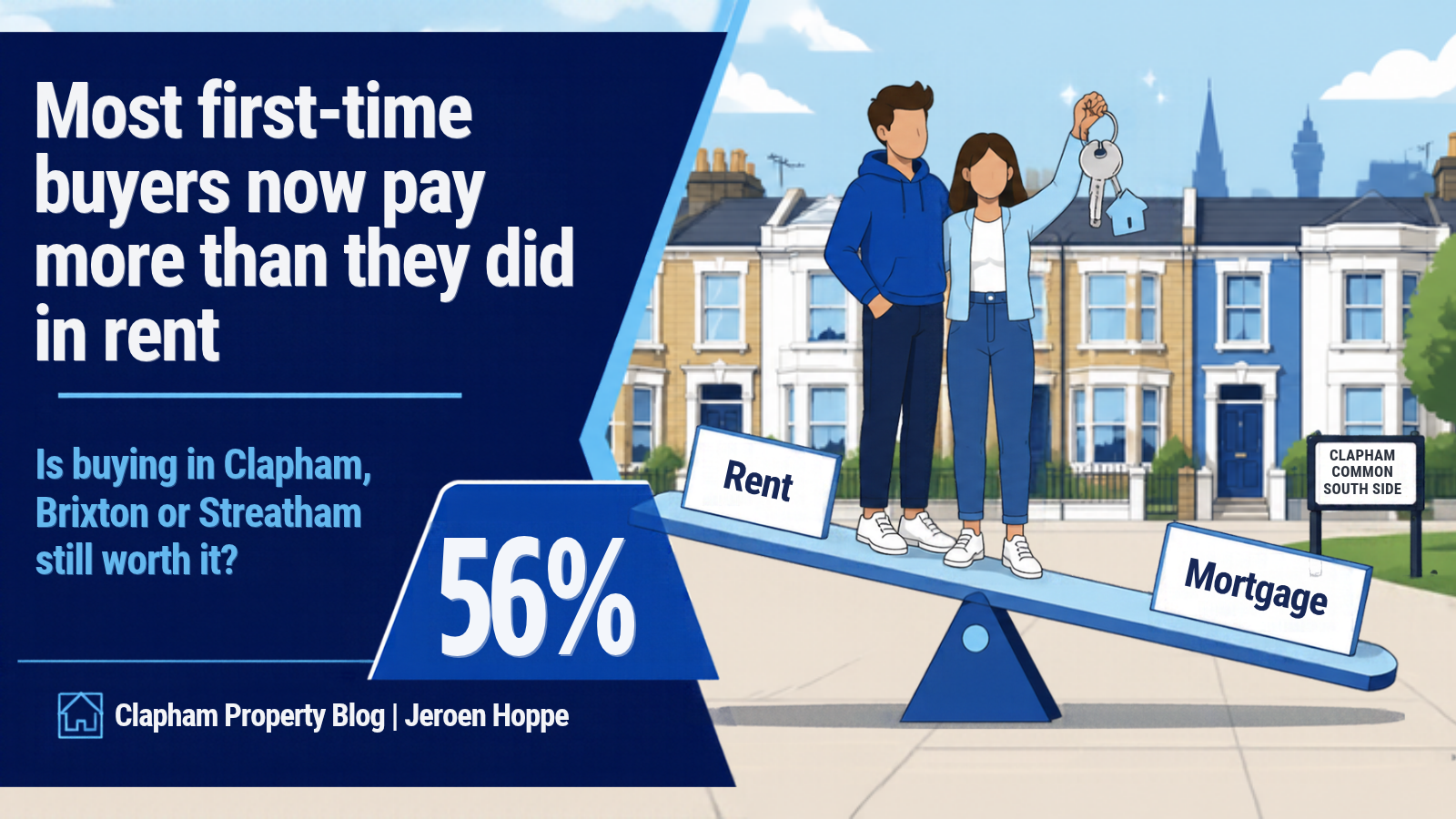
Most first-time buyers now pay more than they did in rent: is buying in Clapham, Brixton or Streatham still worth it?

Most first-time buyers now pay more than they did in rent - Clapham, Brixton and Streatham

For years the maths was simple. Saving the deposit was the hard part, but once you had the keys, your mortgage was usually cheaper than your rent. Not any more.

The cold hard facts

Hamptons, using Connells Group data, found that 56% of first-time buyers who bought in September took on a mortgage payment higher than the rent they left behind. That's the highest share in at least a decade, up from 33% in September 2022.

  • The average first-time buyer's mortgage payment was £1,227 a month, £39 (8.6%) more than their old rent.
  • Those paying more had borrowed at an average 91% loan-to-value, a 9% deposit. Those paying less had a 17% deposit.
  • Buyers in their 40s paid 18.2% more than their old rent. Buyers in their 20s still paid 7.5% less.

Why? Mortgage rates. Since the conflict in the Middle East pushed up swap rates, the average five-year fix has passed 6% for the first time in three years, according to reports. Moneyfacts says the average mortgage deal now stays on sale for just 13 days before it's pulled or repriced.

These are national figures, of course. Here, the numbers are bigger.

So what does it mean for Clapham, Brixton and Streatham?

Hamptons puts the average new let in Greater London at £2,357 a month, up 1.5% on a year ago. Renters in a one-bed off Clapham High Street or a two-bed near Brixton tube will know that number well.

Closer to home, the latest UK House Price Index puts the average price paid by a first-time buyer in Lambeth, which covers most of Clapham, Brixton and Streatham, at £474,320 in August. On rent, my own view is that a typical one-bed round here goes for £1,800 to £2,200 a month.

Who wins and who loses locally?

  • Buyers with a bigger deposit (often thanks to the Bank of Mum and Dad) are still likely to pay less than rent, and they're buying in a market with more stock and more room to negotiate.
  • Buyers stretching on a 5% or 10% deposit will feel the monthly pinch, at least until rates come down.
  • Sellers of one and two-bed flats need to remember who their buyer is. If the monthly maths doesn't work for them, the price has to.

What I'd do now

  1. Run your own numbers: mortgage, service charge and ground rent on a flat, against what you pay in rent today.
  2. Get a mortgage in principle early and be ready to move fast. Deals are disappearing in under a fortnight.
  3. Look at the bigger picture. Every mortgage payment chips away at a debt. Rent doesn't.

My take

The headline sounds gloomy, but I'd read it differently. Paying £39 a month more for a home you own, with security and equity building, isn't a bad deal compared with renting in London, where rents keep rising. The real squeeze is on deposits, not on the principle of buying.

And with this week's Budget and the Bank of England's next meeting in November, rates could move either way. Waiting for the perfect moment rarely works.

So there you have it. Buying costs a bit more each month than it did, but it's still building something.

Are you renting in Clapham or Brixton and wondering whether to make the jump? I'd genuinely like to hear how it's playing out on your street. Drop me a line at jeroen@claphampropertyblog.com or call 07837 093554.

---------
07837 093 554

Sources: Hamptons (Connells Group data), HM Land Registry / ONS UK House Price Index (August 2026), Moneyfacts via Introducer Today, The Guardian, Property Reporter, Estate Agent Today.

Tuesday, 27 October 2026

House prices and rents in Clapham, Brixton & Battersea 2026

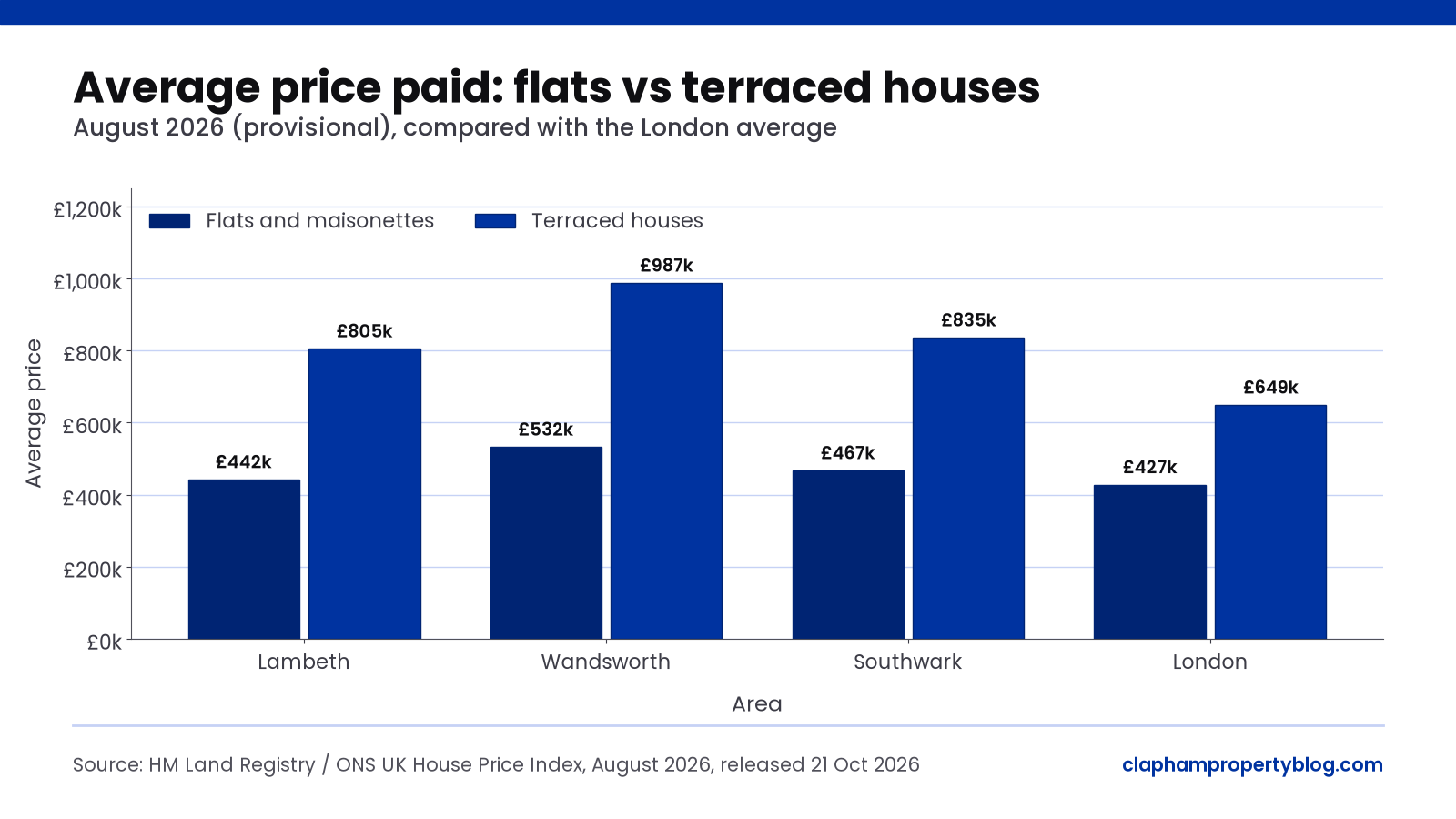
Average price paid for flats and terraced houses in Lambeth, Wandsworth, Southwark and London, August 2026

"What's a flat worth round here?" and "what should I be paying in rent?" are the two questions everyone in South London asks, usually over a drink and usually with a number they read somewhere that's two years out of date.

So let's use the official figures. On 21 October 2026 the ONS and HM Land Registry published the latest house prices (for August 2026) and private rents (for September 2026), borough by borough. Here's what they say for my patch.

One thing first. These are borough averages, not street prices. Lambeth covers most of Clapham, Brixton, Stockwell and Streatham. Wandsworth covers Battersea, Balham, Tooting and Wandsworth itself. Southwark covers Peckham, East Dulwich and Camberwell. A garden flat off Abbeville Road and an ex-local authority flat in Brixton sit in the same Lambeth average, and they're very different animals.

What is the average house price in Clapham and Brixton (Lambeth)?

£540,198 in August 2026, according to the UK House Price Index. That's down 6.5% on a year earlier, a steeper fall than London's 2.2%.

By type, Lambeth flats averaged £441,815 (down 7.2%) and terraced houses £804,615. First-time buyers paid an average of £474,320.

What is the average house price in Battersea and Balham (Wandsworth)?

£694,210, down 5.3% on the year. Wandsworth flats averaged £532,028 (down 6.5%) and terraced houses £986,873. First-time buyers paid £585,383 on average, the highest of the three boroughs.

What is the average house price in Peckham and East Dulwich (Southwark)?

£569,160, down just 2.1% on the year, in line with London. Flats averaged £466,671 (down 2.9%) and terraced houses £835,115. First-time buyers paid £497,815.

For comparison, the London average was £554,430, with flats at £427,310 and terraced houses at £648,650.

How much is rent in Clapham, Brixton, Battersea and Peckham?

ONS figures for September 2026 put the average private rent at:

  • Lambeth: £2,538 a month, up 3.4% on a year ago
  • Wandsworth: £2,640 a month, up 4.1%
  • Southwark: £2,516 a month, up 7.3%
  • London: £2,338 a month, up 3.5%

By bedrooms:

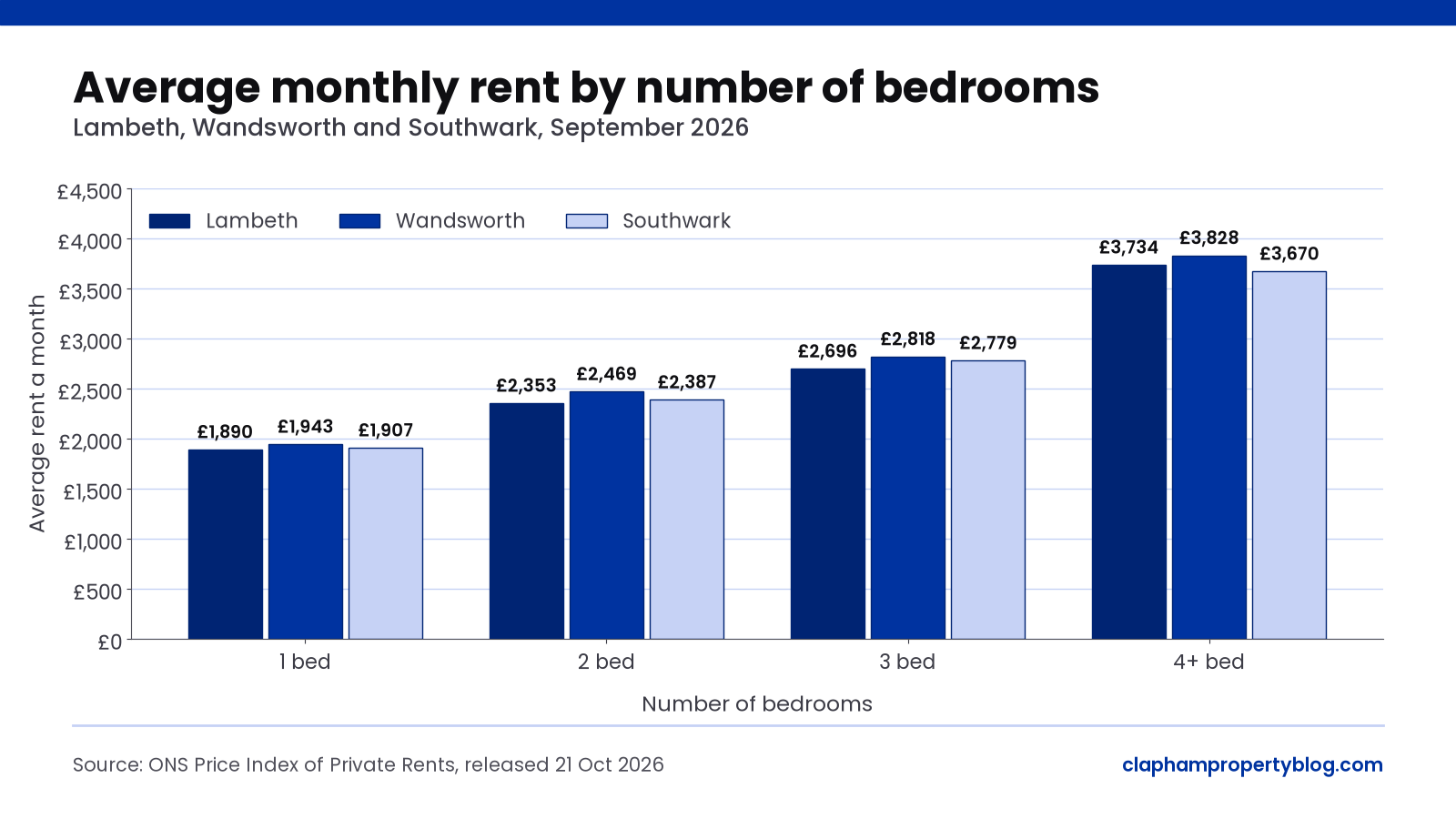
  • One bed: Lambeth £1,890, Wandsworth £1,943, Southwark £1,907
  • Two bed: Lambeth £2,353, Wandsworth £2,469, Southwark £2,387
  • Three bed: Lambeth £2,696, Wandsworth £2,818, Southwark £2,779
Average monthly rent by number of bedrooms in Lambeth, Wandsworth and Southwark, September 2026

So what does it mean for Clapham, Brixton and surrounds?

Now ears must perk up, because two things jump out.

First, rents and prices are going in opposite directions. Lambeth prices fell 6.5% in a year while Lambeth rents rose 3.4%. Southwark rents rose 7.3%, more than double the London rate. Generation Rent is still paying more, while the people who own the bricks and mortar have seen values slip.

Second, flats are taking the hit. In all three boroughs flats fell further than the overall average. I wrote recently about almost four in 10 London flats selling at a loss. This is the same story in the official numbers.

Who wins and who loses?

  • First-time buyers in Lambeth. The average first-time buyer price is down 6.7% in a year. If you've been saving for a flat in Brixton or Stockwell, that's real money off.
  • Flat owners looking to sell. With average flat prices down, pricing it right from day one matters more than ever.
  • Renters, especially in Peckham and East Dulwich. A 7.3% annual rise in Southwark is a big jump on top of already high rents, and sharers are feeling it too: room rents in inner London just hit £1,002.
  • Landlords. Falling prices plus rising rents means better yields for new buyers. Back of an envelope: Lambeth's average flat rent of £2,196 a month is £26,352 a year, about 6.0% gross on the average flat price. In Wandsworth (£2,341 against £532,028) it's about 5.3%, and in Southwark (£2,214 against £466,671) about 5.7%. Before costs, of course, and an average of all rents, not just new lets.

How much is my flat worth in SW4?

The honest answer is that a borough average won't tell you. Floor, outside space, lease length, condition and distance to the tube all move the number, and they can move it a lot.

The quickest way to get a real figure is a proper valuation. I'll come round, look at it, and tell you straight what it would sell or let for, with the comparables.

My take

Here's the thing. The headlines will say "London prices falling" and leave it there. Look closer and it's a flat market, not a house market, and a borough-by-borough market, not a London one. Wandsworth terraced houses still average nearly £1 million. Lambeth flats are down more than 7%.

If you're buying, this is the best negotiating position for years. If you're selling a flat, get the price right and get the presentation right. If you're a landlord, the yield maths is finally starting to work again.

So there you have it. A falling flat market, rising rents, and a lot of difference from one borough to the next.

Quick FAQ

Is it cheaper to rent in Brixton or Clapham? Both are in Lambeth, so the ONS averages don't separate them. Lambeth's average is £2,538 a month.

Which is cheapest to buy: Lambeth, Wandsworth or Southwark? Lambeth, at £540,198 on average in August 2026, then Southwark at £569,160 and Wandsworth at £694,210.

Are South London house prices falling? Yes, on the latest figures. Lambeth is down 6.5%, Wandsworth 5.3% and Southwark 2.1% year on year.

Where do these figures come from? The UK House Price Index (HM Land Registry and ONS) and the ONS Price Index of Private Rents, both published on 21 October 2026.

As always, are you thinking of buying, selling or letting in Clapham, Brixton, Battersea or Peckham and want to know what your place is really worth? I'd genuinely like to hear how it's playing out on your street. Drop me a line at jeroen@claphampropertyblog.com or call 07837 093554.

---------
07837 093 554

Sources: HM Land Registry / ONS UK House Price Index, August 2026 (published 21 October 2026); ONS Price Index of Private Rents, September 2026, and ONS Housing prices in Lambeth, Wandsworth and Southwark (published 21 October 2026). Gross yield figures are my own calculation from those averages.

Saturday, 24 October 2026

Should you buy a modern flat now in Battersea?

Nobody wants flats. That's the line doing the rounds, and for once the numbers back it up. But here's the thing. When everyone runs one way, it's worth asking whether the bargain is going the other.

So what's happening?

The cold hard facts:

  • In June, Zoopla said over two-thirds of one and two-bed flats listed this year were still unsold. First-time buyers stepped back as borrowing costs rose.
  • Zoopla's September index has flats down 1.3% on the year, the only property type falling.
  • Closer to home, the official UK House Price Index puts the average Wandsworth flat at £532,028 in August, down 6.5% in a year.

Why? Leasehold, service charges and cladding. Nine years after Grenfell, the government is monitoring 4,724 buildings of 11 metres and over with unsafe cladding. Work hasn't started on 46% of them, and around 103,000 homes sit in those blocks. In Wandsworth, which covers Battersea and Nine Elms, between 101 and 200 buildings are on the list: 43% finished, 8% under way and 49% still waiting to start.

But what does it mean for Battersea?

Now ears must perk up. Battersea is modern flat country. Think of the riverside blocks, Nine Elms and the Power Station.

And it's not just numbers. Right now I'm seeing a lot of first-time buyers turning away from modern buildings, and that's leaving a lot of value on the table. That's my own observation on the patch, not a statistic.

The contrarian case, made recently by Property Hub (who run their own investor platform), goes like this. Cladding and leasehold problems are temporary. The flat is permanent. Buy while the price is down, and when rates ease the first-time buyers come back. Bear in mind that's a national view. Mine is local: Battersea, street by street.

There's something in it. Renters clearly like modern. Zero Deposit says build-to-rent homes in London average £2,560 a month against £2,280 for the wider market. Wandsworth private rents averaged £2,640 in September, up 4.1% in a year. And 89% of new homes get an A or B energy rating, while landlords face an EPC C standard by October 2030, with spend capped at £10,000 a property.

The catch

Let's face it, cheap can stay cheap.

  • Rates aren't easing yet. The Bank of England held Bank Rate at 3.75% in September, and three of the nine committee members voted for a rise. Next decision: 5 November.
  • Service charges. Concierge, gym and pool cost money. Ask for three years of accounts.
  • EWS1 and remediation. Has the building been assessed, who's paying, and when does work finish? Your lender will ask too.
  • Lease and ground rent. Check the years left and the ground rent.
  • Resale. If most flats listed this year haven't sold, plan for when it's your turn to sell.

My take

Buy the building, not the brochure. A modern Battersea flat with a long lease, a clean bill of health on the walls and a sensible service charge, bought at today's prices, looks like decent value to me. One with an open remediation question is a gamble, not a bargain. This isn't financial advice, so take independent advice, of course.

So there you have it. Unloved isn't the same as unwise. But in the flat market, the detail is everything.

Are you eyeing a flat in Battersea or Nine Elms, or sitting on one waiting for the market to turn? I'd genuinely like to hear how it's playing out on your street. Drop me a line at jeroen@claphampropertyblog.com or call 07837 093554.

Sources: Zoopla press release (30 June 2026); Zoopla House Price Index, September 2026 (1 October 2026); HM Land Registry / ONS UK House Price Index, August 2026, and ONS Housing prices in Wandsworth (21 October 2026); MHCLG Building Safety Remediation monthly data release, August 2026 (30 September 2026); Zero Deposit build-to-rent research (June 2026); MHCLG Energy Performance of Buildings Certificates, April to June 2026 (30 July 2026); DESNZ private rented homes energy performance government response (January 2026); Bank of England Monetary Policy Summary (17 September 2026); Property Hub, "Nobody Is Buying These UK Properties (They're Buying This Instead)" (YouTube).

Uploaded Image

Friday, 23 October 2026

Autumn Budget countdown: four in 10 landlords say they'd raise rents if taxes rise - what it means for Clapham and Brixton

The Autumn Budget is almost upon us, and if you're a landlord you can probably feel your shoulders creeping up towards your ears already.

A new survey has put numbers on the mood. And, as usual, the people who'd feel the consequences most aren't the landlords at all. It's the renters.

So what's the survey saying?

LegalforLandlords asked 544 UK private landlords how they feel ahead of the Budget, which is due on 28 October. The cold hard facts:

  • 59% are pessimistic about the Budget.
  • Just 28% are confident that letting property will still be financially worthwhile in five years' time.
  • Capital Gains Tax is the biggest worry for 22%, income tax on rental income for 20%, and the cost of possible energy efficiency upgrades for 18%.
  • If the Chancellor raises the tax burden on landlords, 40% say they'd put rents up where they can. 18% would consider selling and 16% would leave the rented sector altogether.

To be fair to the researchers, they point out these are landlords' stated intentions, not a prediction of exactly what will happen. Still, it's a fairly clear message.

And bear in mind this isn't starting from a clean slate. As Property118 has reminded readers, last year's Budget already announced two percentage point increases in tax rates on property income from April 2027.

The Capital Gains Tax argument

Meanwhile the National Residential Landlords Association (NRLA) is lobbying for Capital Gains Tax reform in this Budget. Its argument is simple, and I have to say I agree with it.

At the moment, when you sell, the whole rise in value is treated as profit (apart from certain capital costs). The NRLA's research found that only around one-fifth of the rise in house prices between 2015 and 2024 was a real-terms gain - the rest was inflation. So it wants two changes:

  1. Tax the real gain, not inflation, by adjusting the purchase price and qualifying spending for inflation before working out the gain.
  2. Give relief for long-term holding, so someone who has housed tenants for years is treated differently from a short-term flipper.

As NRLA chief executive Ben Beadle put it: "It is absurd that investors face Capital Gains Tax on increases in property prices that are simply the result of inflation. That's not a real gain, and it shouldn't be treated as one."

The NRLA also points to Rightmove data showing each available rental property now attracts an average of 10 enquiries, double the pre-pandemic figure. Demand isn't the problem. Supply is.

So what does it mean for Clapham, Brixton and surrounds?

Now ears must perk up, because CGT is a very South London issue.

Picture a landlord who bought a flat off the Northcote Road or a two-bed conversion in Brixton 15 or 20 years ago. On paper, that's a big gain. In real terms, a good chunk of it is simply the pound being worth less. Under the current rules, the taxman doesn't care.

That landlord has three choices: sell and pay up, hold on and hope, or put the rent up to make the numbers work. The survey suggests a fair few will do the last one.

Who wins and who loses locally?

  • Renters in Clapham, Brixton and Streatham. If landlords' costs go up again, the survey suggests rents follow. With competition for every decent flat already fierce, renters have very little room to push back.
  • Long-standing landlords with big paper gains. CGT reform along the NRLA's lines would help them most. A tax rise would hit them hardest and could push some to sell up - which, of course, means one less rental home on the market.
  • Buyers. If more landlords sell, first-time buyers in places like Streatham and Tulse Hill could see a bit more choice. That's the silver lining, but it doesn't help the tenant who has to move out.
  • Newer, smaller landlords. Squeezed from both sides - higher tax on rental income from 2027 and rising compliance costs.

My take

Here's the thing. Every time the Treasury goes looking for money in the rented sector, the bill ends up on the tenant's doormat. It's not because landlords are greedy. It's because the sums have to add up, and if they don't, the flat gets sold.

The NRLA's CGT idea is sensible. Taxing inflation as if it were profit isn't fair, and it actively discourages landlords from staying in for the long term - which is exactly the kind of landlord renters want.

Will the Chancellor listen? I'm not holding my breath. My advice in the meantime: don't make a knee-jerk sale based on rumours. Run the numbers on your own portfolio, speak to your accountant, and wait to see what's actually announced. Take independent advice, of course.

So there you have it. A nervous few days for landlords, and potentially an expensive year for renters.

Are you a landlord in Clapham or Brixton weighing up whether to hold or sell before the Budget, or a renter worried about what comes next? I'd genuinely like to hear how it's playing out on your street. Drop me a line at jeroen@claphampropertyblog.com or call 07837 093554.

---------

07837 093 554

Sources: LegalforLandlords survey via Property Reporter (16 October 2026) and Property Soup (19 October 2026), NRLA via Property Reporter (16 October 2026), Property118 (15 and 16 October 2026).

Uploaded Image

Thursday, 22 October 2026

Almost four in 10 London flats sell at a loss: what it means for flat owners and buyers in Clapham, Battersea and Brixton

Here's a headline to put you off your morning coffee. Almost four in 10 London flats that were resold after five to 10 years went for less than the owner paid for them.

Not a typo. Four in 10. And before the doom merchants get going, let's look at what the numbers actually say, and what they mean if you own, or want to buy, a flat South of the River.

So what's happening?

The figures come from e.surv Chartered Surveyors' October house price report, which compared repeat sales using HM Land Registry and Registers of Scotland data over the 12 months to August 2026.

The cold hard facts:

  • Across Great Britain, just over a quarter of flats resold after five to 10 years of ownership fetched less than their previous purchase price.
  • In London it was almost four in 10 - the highest proportion in the country.
  • Among London houses held for the same period, fewer than 4% sold at a loss.
  • Around a third of flats in the South East and East of England sold for less than they cost. In the Midlands and the North it was closer to one in five, and in Scotland fewer than one in 10.
  • Holding on longer didn't make the problem disappear. Across Great Britain, 16.6% of flats resold after 10 to 15 years fetched less than their previous price, against 1.9% of houses.

e.surv says flats and houses started to pull apart around 2017, as leasehold, building safety, cladding and service charges increasingly shaped the decisions of buyers, sellers and lenders. Interestingly, the gap is much narrower in Scotland, which has a different system for owning and managing flats. The report is careful to say that doesn't prove tenure is the cause, but it suggests the way flats are owned and managed may matter.

And the wider backdrop? The average home in Great Britain was £328,900 in September, down 0.2% on the month and the quarter, but still 1.5% up on a year earlier. London was the only region where prices fell over the year, down 2.3%.

If you want to feel even worse, a Telegraph analysis of Land Registry data put 76% of flats in England and Wales as loss-making in the 12 months to August once you allow for inflation. That's a real-terms figure, mind, not cash.

But what does it mean for Clapham, Battersea and Brixton?

Now ears must perk up, because our patch is flat country. Think of the converted Victorian terraces off Abbeville Road and Lavender Hill, the mansion blocks around Clapham Common, the ex-local authority flats in Stockwell and Brixton, and the newer glass towers along the river at Nine Elms and Battersea.

They are not all the same product, and buyers know it. Bear in mind what the report points to: leasehold terms, building safety and service charges. Those are exactly the things buyers and their lenders now pick apart on every flat purchase.

So, roughly speaking, here's who wins and who loses locally:

  • Sellers who bought a flat around 2016-2019. This is the group most likely to feel it. If you bought at or near the last peak and haven't added value since, a nominal loss is a real possibility.
  • Owners in blocks with cladding questions or chunky service charges. Expect buyers to ask harder questions and lenders to be choosier. Get your paperwork (lease length, service charge history, any fire safety documents) together before you list, not after an offer.
  • First-time buyers. Let's face it, this is good news for you. More choice, more room to negotiate, and sellers who are realistic about price. Do your homework on the lease and the building, though, because the reasons prices are soft are the same things that could bite you when you come to sell.
  • Landlords. A flat that hasn't grown in value can still earn its keep if the rent covers the costs. Yield and capital growth are two different questions.

My take

You see, here's the thing. A flat is not a bad investment because it's a flat. It's a bad investment when you overpay, buy a short lease, ignore the service charge or buy into a building with safety issues hanging over it.

The data tells me flat buyers have got wiser, and lenders more careful. Sellers need to catch up. Price it right, have the leasehold pack ready on day one and be honest about the building. The flats that are presented properly still sell. The ones that aren't sit there, and then the price comes down anyway.

Houses, meanwhile, keep doing what houses do in London. If you're a flat owner thinking about the next step up the ladder, the numbers are a reminder to look at the whole move, not just your sale price.

So there you have it. Not quite doom and gloom, but a clear message: in the flat market, the detail is everything.

Do you own a flat in Clapham, Battersea or Brixton and wonder where you stand, or are you a buyer weighing up a flat against a small house? I'd genuinely like to hear how it's playing out on your street. Drop me a line at jeroen@claphampropertyblog.com or call 07837 093554.

---------

07837 093 554

Sources: e.surv Chartered Surveyors October 2026 house price report via Property118 (12 October 2026), The Negotiator (8 October 2026), The Telegraph (2 October 2026).

Uploaded Image

Tuesday, 20 October 2026

The landlord register isn't a one-off: the 28-day rule for landlords in Clapham, Brixton and surrounds

A Facebook post has been doing the rounds. It says the new landlord register is NOT a one-off form but a "live record", where every change - a new gas certificate, a rent rise, even your tenant's partner moving in - must be updated within 28 days or you face a fine of up to £7,000. And, of course, there's a handy checklist "in the comments".

Credit where it's due, the post is mostly right. But "mostly" is doing a lot of work there.

So what's actually happening?

The register comes from the Renters' Rights Act 2025, with the detail in the draft PRS Database Regulations 2026, laid before Parliament on 9 September. Two things the post leaves out:

  • The regulations are still a draft. Both Houses have to approve them before they're made.
  • The penalties aren't in force. They need a separate commencement order, which hadn't been made when I checked.

Nobody in SW4 is getting fined next week.

The 28-day rule

Under the draft regulations, when any information or document on your landlord or property entry "becomes out of date", you have 28 days to update it. Registering isn't fire and forget.

What's on the record for each property:

  • the number of occupants and households
  • HMO, additional or selective licence status and numbers
  • the gas safety record, EICR and EPC
  • the rent, how often it's paid and which bills are included
  • whether it's furnished, and whether it's currently let

So yes, a partner moving in changes the occupant count, and the NRLA reads renewed certificates and rent changes as updates too. (The draft regulations don't list trigger events, and official GOV.UK guidance isn't out yet.)

But "every change"? No. Tenant names, deposits and repairs aren't on the list. Fixing the boiler isn't a register event in itself.

It's annual too

Entries must be renewed every 12 months. GOV.UK puts the fee at £65 per property per year, though it can change. And if you have more than one property, they all share the renewal date of your first one.

Quick numbercrunch for a landlord with three flats: 3 x £65 = £195 a year, all due on the same day. Put it in the diary.

What the penalties really are

  • Up to £7,000 for failing to register or keep entries up to date. That's a maximum. Each council sets the amount, and there's no minimum.
  • Up to £40,000, or prosecution, for knowingly or recklessly giving false information, carrying on more than 28 days after a penalty is final, or another breach within five years of a penalty.
  • No rent repayment order just for being unregistered. An RRO only comes into play for the false-information offence, or for carrying on after a penalty.
  • No possession order without an active entry. Apart from two anti-social behaviour grounds, a court can't make a possession order while you have no active landlord or property entry. An entry you didn't renew counts as inactive, and so does one where the tenancy and safety details weren't added within 28 days.

A correction from me

In my last post on the register I said the penalty for ignoring it could be two years' rent. That overstated it. Simply not registering means a penalty of up to £7,000 and a block on possession, not a rent repayment order. I also said tenants will be able to check whether their landlord is registered. That's the plan, but not at launch - public access needs further legislation and there's no date yet. I'd rather tell you straight.

But what does it mean for Clapham, Brixton and surrounds?

London is the second-last region. Duties start on 15 July 2027 and the deadline is 14 October 2027, for Lambeth, Wandsworth and Southwark alike. So Streatham, Brixton, Battersea and most of Dulwich all register in the same window. It depends on where the property is, not where you live.

Picture an accidental landlord with one flat off Abbeville Road. She registers in August 2027 and forgets about it. Next spring her tenant's partner moves in and the rent goes up. On the NRLA's reading that's two updates, each with its own 28-day clock. Then, in August 2028, the renewal.

A letting agent can update the tenancy and safety details and whether the property is let. What they can't do is register you in the first place. That's on you.

Who wins? Organised landlords with one folder per property. Who loses? The shoebox brigade.

About that checklist in the comments

I'm not calling any particular post a scam. But "link in the comments" is a classic engagement-bait trick, and those links are sometimes lead-capture forms, paid "compliance packs" or pages dressed up to look like GOV.UK. Register only through the official GOV.UK service (or its official paper form), where the only fee mentioned is £65 per property. Don't pay a third party to "register" you, and be suspicious of any unsolicited "register now" message before the service opens on 15 December 2026.

My take

The post is broadly right, just early and breathless. Good landlords already know when their gas certificate is due. The real risk in Clapham and Battersea isn't a £7,000 fine landing on the doormat. It's a stale entry quietly going inactive just when you need possession.

In summary

So there you have it. A 28-day update duty for the listed items, an annual £65 renewal on one shared date, and penalties not switched on yet. London's window is 15 July to 14 October 2027.

Are you a landlord in Clapham, Brixton or Dulwich, and have you got a system for keeping your paperwork current? I'd genuinely like to hear how it's playing out on your street. Drop me a line at jeroen@claphampropertyblog.com or call 07837 093554.

---------

07837 093 554

Sources: Draft PRS Database Regulations 2026 and Explanatory Memorandum (legislation.gov.uk), Renters' Rights Act 2025, GOV.UK Housing Hub, GOV.UK civil penalties guidance, NRLA.

Uploaded Image

Saturday, 17 October 2026

The landlord register opens in December: what landlords in Clapham, Brixton and Streatham need to do now

For the first time ever, England is going to keep a single list of who lets property and where. Scotland, Wales and Northern Ireland have had one for years. Now it's our turn, and it comes with a fee, a deadline and a lot of paperwork.

So what's happening?

The new Private Rented Sector Database, better known as the landlord register, opens in the West Midlands on 15 December 2026. Other English regions follow in stages until August 2027, according to Property Reporter (16 October). Landlords will have three months to register once their region opens, and the fee is £65 a year per property.

To register, you'll need each property's gas safety record, electrical safety report and EPC. Property Reporter's guest piece from Logan Ransley of Landlord Studio (12 October) makes the point that this is where many landlords will discover something missing or out of date. That gas certificate buried in an old email. The electrical report that quietly expired last spring.

And there's teeth. Tenants will be able to check whether their landlord is registered, and once the rules are fully in force a tenant renting from an unregistered landlord can apply to get back up to 24 months' rent. Two years' rent. That should focus a few minds.

Councils are also being funded to enforce the Renters' Rights Act. Ransley's FOI request found Newham's funding more than doubled in a year, from around £169,000 in 2025/26 to more than £364,000 in 2026/27, even though Newham landlords won't have to register until next summer.

It all lands in a busy year. Making Tax Digital started in April for landlords with qualifying income over £50,000, most of the Renters' Rights Act came into force in May, and Property Reporter (12 October) noted only 35% of landlords can name their own MTD start date. TwentyCi found around 560 rental properties a day were sold in Q3 2026, up from around 500 a day a year earlier and fewer than 170 in 2020.

But what does it mean for Clapham, Brixton and surrounds?

Our patch straddles Lambeth, Wandsworth and Southwark, with Streatham and Brixton in Lambeth, Battersea in Wandsworth and Dulwich mostly in Southwark. If Newham's "next summer" is a guide, London landlords probably have a few months yet. Registration for Lambeth, Wandsworth and Southwark landlords is expected in 2027.

Bear in mind that your deadline depends on where the property is, not where you live. If you live in Dulwich but own a flat in Birmingham, you could be registering that one first, from 15 December.

Think about who lets in our area. Accidental landlords who kept a flat in Clapham Old Town when they moved out to start a family. Long-term investors with a few conversions off Streatham Hill. Owners of new-build flats around Battersea Power Station. The professional, fully managed landlord will barely notice. It's the one-flat, do-it-yourself landlord who is most likely to be caught out.

Quick numbercrunch for a landlord with three flats:

  • Registration: 3 x £65 = £195 a year
  • Risk of not registering: up to 24 months' rent per tenancy

Not a hard choice.

Who wins and who loses?

  • Good landlords. Mostly fine. As Dirk Dette of Campions Group put it via Property Reporter, the information requested largely relates to obligations landlords should already be meeting. The difference is that gaps become visible.
  • Disorganised landlords. Expired certificates and missing paperwork will show up quickly.
  • Rogue landlords. That's the theory, anyway. Veco's chief executive Richard Murray asks the obvious question: will those determined to operate outside the rules simply choose not to register?
  • Tenants. A public way to check their landlord is legitimate, and a powerful remedy if not.

My take

I'll be honest, I share Veco's scepticism. The compliant majority will dutifully pay their £65 and upload their certificates, while the cowboys at the bottom of the market carry on as before unless councils have the people and the will to chase them. The Newham funding figures suggest the money is starting to arrive. Whether that becomes enforcement on the ground in Lambeth and Wandsworth is another matter.

That said, I'm not going to pretend this is a disaster. Another layer of admin, yes. Another £65 per property, yes. But for good landlords it's a chance to prove they do things properly, and in a market where tenants have more choice than ever, being visibly compliant could become part of what you're selling.

Practical steps for now, borrowing Ransley's three-step plan: check which region each of your properties sits in; pull all certificates, expiry dates and tenancy agreements into one place per property; and start logging rent, costs and tenant messages as they happen rather than at year end. An hour a month beats a lost week when the council or HMRC comes knocking.

In summary

So there you have it. The register opens on 15 December, costs £65 a year per property, and the penalty for ignoring it could be two years' rent. London's turn looks like 2027, but the paperwork you'll need is paperwork you should already have.

Are you a landlord in Clapham, Brixton or Streatham, and is your certificate folder in order, or more of a shoebox? I'd genuinely like to hear how it's playing out on your street. Drop me a line at jeroen@claphampropertyblog.com or call 07837 093554.

---------

07837 093 554

Sources: Property Reporter (12 and 16 October 2026), Landlord Studio, Veco, Campions Group, TwentyCi.

Uploaded Image

Friday, 9 October 2026

Room rents in inner London just hit £1,002: what it means for sharers in Clapham


Spend ten minutes on the Common on a Saturday and you'll spot them: two or three mates, coffees in hand, walking back from a viewing they've just queued for. Flatshares are the engine room of Clapham. They always have been. And this week the numbers caught up with what I've been seeing on the ground all autumn.

Room rents in inner London have reached an average of £1,002 a month. That's up 2.3% on the quarter and 1.1% on a year ago, and it's within a pound of the all-time record of £1,003 set at the end of 2023 (figures reported this week via SpareRoom). Nationally, the average UK room now costs £769 a month, itself a fresh record, up 1% on the year. So renting a single room in a shared flat down here now costs more than renting a whole one-bed does in large parts of the country.

It isn't a blip either. Surveyors expect more of the same: a net 37% of them told RICS they think rents will keep rising over the next three months. Demand is up, supply is down, and nothing in the pipeline suggests that flips soon.

For a young professional moving to Clapham, Balham or Stockwell, the sum is sobering. A £1,002 room is roughly £12,000 a year before a single bill, before council tax, before the Northern line. Share a three-bed off Abbeville Road or near Clapham Common and the landlord is collecting around £3,000 a month for the flat. That's why so many sharers I speak to are staying put rather than moving in the autumn. The devil you know is cheaper than the devil advertised on the portal.

For landlords, it looks like a win, and in cash terms it is. But I'd read it with a cool head. Rents at or near record highs are not a sign of a healthy market. They're a sign of a market that has run out of homes. Tenant demand keeps climbing while rental stock keeps shrinking, and squeezing more out of a smaller pool is not a strategy, it's a symptom. When affordability stretches this far, you get more arrears, more churn and more tenants who simply can't take the next increase.

Here's my take. If you're a sharer in SW London, the smart move right now is to lock in. A good flat with decent flatmates at a fair rent is worth holding through the winter rather than rolling the dice in a market where every viewing has a queue behind you. Talk to your landlord about a longer term before your renewal lands, because stability cuts both ways and most will take a reliable tenant over a void. And if you're a landlord sitting on a flat that works, resist the temptation to chase the headline number to the last pound. The best tenants are the ones who stay, and in this market keeping a good one is worth more than a £50 bump that pushes them out the door.

Are you sharing in Clapham and feeling the squeeze, or a landlord weighing up a renewal this winter? I'd genuinely like to hear how it's playing out on your street. Drop me a line at jeroen@claphampropertyblog.com or call 07837 093554.


---------

07837 093 554

Do I need a landlord licence in Clapham, Brixton or Battersea? Lambeth, Wandsworth and Southwark explained

The question I get from landlords more than almost any other isn't about rents. It's "do I actually need a licence for my f...

Popular Post!